
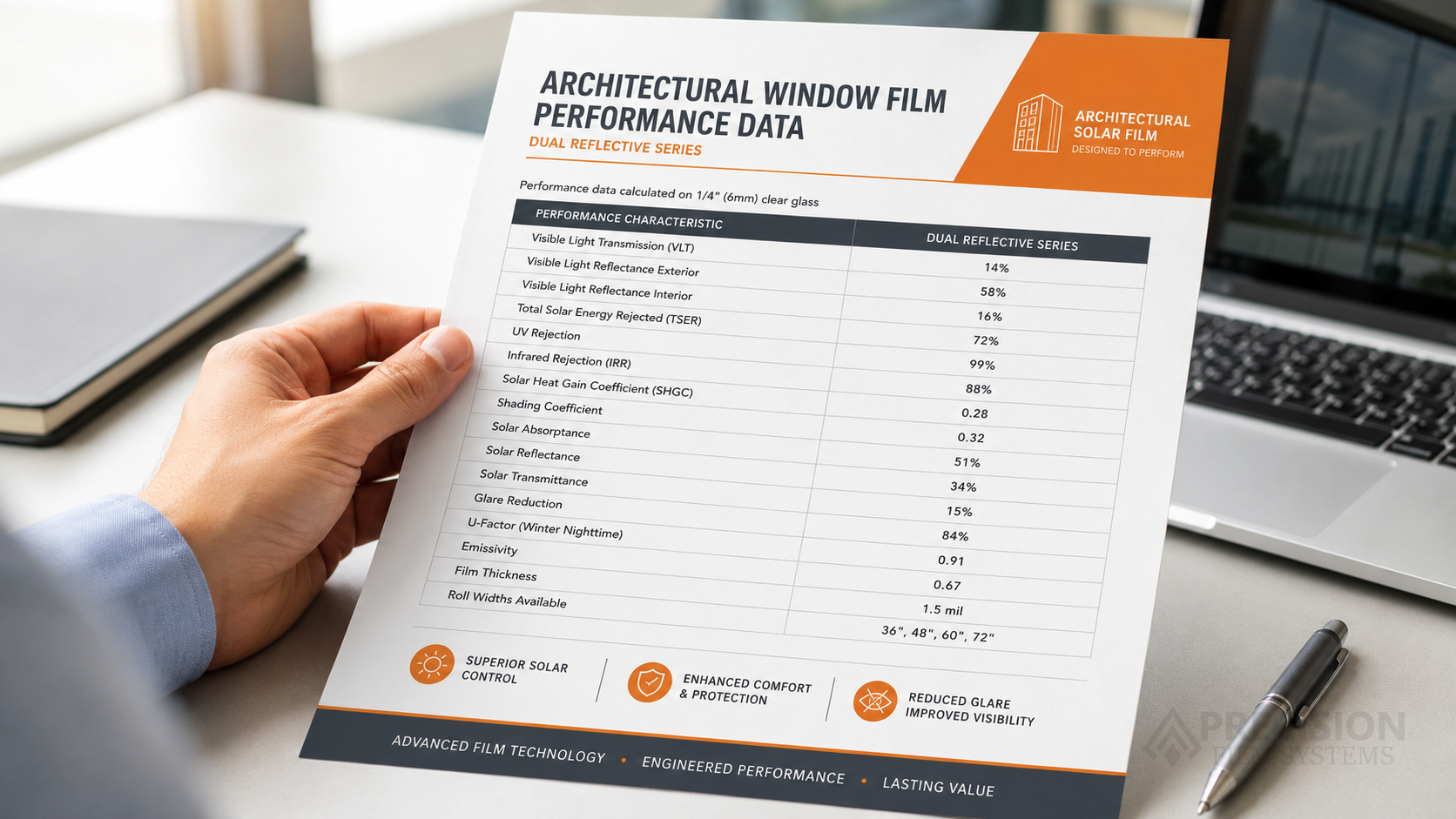
Window film spec sheets can be useful, but they are easy to misread when one number gets treated like the whole story.
This glossary explains common flat glass window film terms in plain English. It is written for installers, estimators, salespeople, and customers who want to understand what the numbers mean before comparing film options, preparing a quote, or talking through job conditions.
A spec sheet can help narrow the conversation. It should not replace glass type, exposure, shading, manufacturer guidance, customer goals, or the real conditions of the job. For that side of the decision, use the Glass and Film Compatibility Awareness path.
How to use this glossary
Use this page as a quick reference when you run into a term on a film spec sheet, quote, product card, or customer request.
Some terms describe appearance. Some describe heat performance. Some describe privacy. Some affect material planning. The mistake is assuming one term explains everything.
For example:
- A darker film does not automatically mean better total heat performance.
- A high IR rejection number is not the same thing as total heat rejection.
- A privacy film that works during the day may not provide the same privacy at night.
- A square footage total does not always tell you how much film you need to order.
- A compatibility question should not be answered from one spec number alone.
Core performance terms
VLT / Visible Light Transmission
VLT stands for visible light transmission. It describes how much visible light passes through the glass and film.
A higher VLT means more daylight comes through. A lower VLT usually means the film looks darker and reduces more visible brightness.
VLT matters when the customer is asking about daylight, glare, appearance, or how dark the glass will look. It does not tell you the full heat performance of a film by itself.
Related article: What VLT Means on a Window Film Spec Sheet
TSER / Total Solar Energy Rejected
TSER stands for total solar energy rejected. It is a performance number used to describe how much total solar energy is rejected by the glass and film system.
TSER can be useful when comparing heat-control films, but it should not be used as the only number in the conversation. Glass type, film location, VLT, reflectance, absorption, SHGC, exposure, and customer goals all matter.
Related article: What TSER Means and Why It Is Not the Whole Story
IR Rejection
IR rejection describes how much infrared energy a film rejects within the range being measured.
This number is commonly used in marketing because infrared energy is associated with heat. The catch is that IR rejection is not the same thing as total heat rejection. Different manufacturers may measure or promote IR rejection in different ways, so the number needs context.
Related article: IR Rejection vs Heat Rejection: Plain-English Difference
Heat Rejection
Heat rejection is a broader phrase people use when talking about how much solar heat a film helps reduce.
The problem is that "heat rejection" can be used casually, while spec sheets may list more specific measurements such as TSER, SHGC, or IR rejection. When a customer says they want heat rejection, the better question is what problem they are trying to solve: hot rooms, sun-facing glass, comfort near windows, HVAC load, glare, or all of the above.
UV Rejection
UV rejection describes how much ultraviolet radiation a film blocks or rejects.
UV rejection matters for comfort, skin protection discussions, and fading conversations, but it should not be oversold. Fading is affected by more than UV. Visible light, solar heat, materials, humidity, and other conditions can also play a role.
Related article: UV Rejection: What It Does and Does Not Tell You
SHGC / Solar Heat Gain Coefficient
SHGC stands for solar heat gain coefficient. It describes how much solar heat passes through a window system.
A lower SHGC generally means less solar heat gain. That can matter in hot, sunny conditions where the goal is to reduce heat entering the space. But like TSER, SHGC belongs inside a larger conversation about the glass, film, building, exposure, and customer goals.
Related article: SHGC Explained for Window Film Conversations
U-Factor / U-Value
U-factor, also called U-value, describes non-solar heat transfer through a window system.
In plain English, it relates more to insulation and heat movement through the glass assembly than direct sun heat. A lower U-factor usually means better resistance to heat transfer.
For many everyday solar film conversations, U-factor may not be the first number discussed. It becomes more relevant when energy performance, insulating value, Low-E glass, or commercial specifications are part of the job.
Related article: U-Factor and Window Film: What Installers Need to Know
Light, reflection, and appearance terms
Visible Reflectance
Visible reflectance describes how much visible light is reflected away from the glass and film surface.
Higher visible reflectance can make glass look more mirror-like, especially from the brighter side. This can affect appearance, glare, privacy expectations, and customer approval.
Interior Reflectance
Interior reflectance describes how reflective the glass and film may appear from inside the building.
This matters when customers care about nighttime appearance, interior views, or how much reflection they may see from inside after installation.
Exterior Reflectance
Exterior reflectance describes how reflective the glass and film may appear from outside the building.
This matters for storefronts, homes, offices, HOA concerns, design requirements, and any job where outside appearance is part of the decision.
Related article: Visible Reflectance, Interior Reflectance, and Exterior Reflectance
Absorptance
Absorptance describes how much solar energy is absorbed by the glass and film system.
Absorbed energy can become important in compatibility conversations because absorbed heat affects the glass system. Absorptance should not be separated from glass type, film type, exposure, shading, and manufacturer guidance.
Reflectance
Reflectance describes how much energy or light is reflected away.
In film conversations, reflectance may come up around appearance, privacy, glare, and solar performance. The important point is to ask what kind of reflectance is being discussed: visible reflectance, solar reflectance, interior reflectance, or exterior reflectance.
Transmittance
Transmittance describes how much energy or light passes through.
Visible light transmission is one kind of transmittance. Solar transmittance is another. When reading a spec sheet, make sure the term is tied to the right part of the spectrum or the right performance category.
Related article: Total Solar Absorbance, Reflectance, and Transmittance on Film Specs
Glare Reduction
Glare reduction describes how much a film helps reduce uncomfortable brightness.
Glare reduction is closely tied to visible light, but it is not the same as total heat rejection. A customer with screen glare in a conference room may need a different conversation than a customer with a hot lobby or a sun-facing office.
Related article: Glare Reduction: How to Explain It Without Overpromising
Glass and energy terms
Emissivity
Emissivity describes how a surface emits radiant heat.
This term often comes up around Low-E glass and energy performance. For most customers, the important point is not the textbook definition. The important point is that emissivity is part of how glass systems manage heat transfer.
Low-E
Low-E stands for low emissivity. Low-E glass has a coating designed to affect heat transfer.
Low-E questions matter because the existing glass system can affect film selection and compatibility. When Low-E glass is involved, it is worth slowing down and checking manufacturer guidance instead of choosing film from appearance or heat numbers alone.
Related article: Emissivity and Low-E: Plain-English Definitions
Film category and construction terms
Film Thickness
Film thickness describes how thick the film is.
Thickness matters more in some categories than others. For example, safety and security films are often discussed by thickness because holding broken glass together is part of the purpose. For solar control films, thickness alone should not be treated as a universal quality score.
Mil Rating
A mil is one-thousandth of an inch. A film listed as 4 mil is about 0.004 inches thick.
Mil rating is useful when comparing certain film categories, especially safety and security film, but it does not tell you everything about adhesive, construction, performance, warranty, or job suitability.
Related article: Film Thickness and Mil Ratings
Safety Film
Safety film is designed to help hold broken glass together after impact or breakage.
It is usually discussed differently than solar film because the goal is not just heat, glare, or appearance. Safety film conversations may involve thickness, attachment systems, specifications, building requirements, and customer expectations.
Solar Film
Solar film is used to reduce solar-related problems such as heat, glare, UV exposure, and sometimes privacy.
Solar film selection usually involves performance numbers, appearance, glass type, exposure, and customer goals. A solar film should not be chosen from darkness alone.
Related article: Safety Film vs Solar Film: Planning Differences
Neutral Film
Neutral film is usually designed to keep a more natural, less reflective appearance.
Customers may ask for neutral film when they want performance without a strong mirrored look. Neutral appearance does not automatically answer heat, glare, privacy, or compatibility questions by itself.
Reflective Film
Reflective film has a more mirror-like appearance and often reflects more visible light than neutral-looking films.
Reflective films can help with daytime privacy and solar control, but they require careful expectation-setting around appearance, lighting conditions, and nighttime privacy.
Dual-Reflective Film
Dual-reflective film is designed with different reflectance characteristics on each side of the film.
In plain English, it may look more reflective from the exterior while reducing the mirror-like effect from the interior compared with some traditional reflective films. The exact appearance depends on the product and lighting conditions.
Ceramic Film
Ceramic film uses ceramic technology rather than metalized construction.
Ceramic films are often discussed when customers want heat performance with a less reflective look or when metal interference is a concern. That does not mean ceramic is automatically the best choice for every flat glass job.
Metalized Film
Metalized film includes metallic layers or components.
Metalized films may offer strong solar performance and a reflective appearance, depending on the product. They can be a good fit in the right situation, but the recommendation still depends on the glass, goal, appearance preference, and manufacturer guidance.
Related article: Neutral, Reflective, Dual-Reflective, Ceramic, and Metalized Film
Privacy and decorative film terms
Daytime Privacy
Daytime privacy usually depends on the light difference between the outside and inside.
Reflective film may make it harder to see in during the day when the outside is brighter than the inside. That privacy effect can change when lighting conditions change.
Nighttime Privacy
Nighttime privacy is commonly misunderstood.
If the inside of the building is brighter than the outside at night, reflective privacy may reverse or become much less effective. Customers should understand this before approving a film for privacy.
Related article: Daytime Privacy and Nighttime Privacy
Decorative Film
Decorative film is used to change the look of glass.
It may be used for branding, design, distraction markers, privacy, or interior glass features. Decorative film is usually not selected primarily for solar heat performance.
Frosted Film
Frosted film gives glass a frosted or etched appearance.
It is often used for privacy while still allowing light through. Frosted film can obscure clear views, but it is not the same thing as blackout film.
Translucent Film
Translucent film allows light through but blurs or blocks a clear view.
This term is useful when a customer wants privacy without making the glass fully opaque.
Opaque Film
Opaque film blocks visibility through the glass.
It is used when the goal is to prevent see-through visibility rather than simply soften the view. Opaque film can also change how much light enters the space, depending on the product.
Related article: Decorative, Frosted, Translucent, and Opaque Film Terms
Material planning terms
Roll Width
Roll width is the width of the film roll, such as 36 inches, 48 inches, 60 inches, or 72 inches.
Roll width matters because windows do not always fit efficiently on every roll size. Two jobs with similar square footage can require different amounts of film depending on window sizes, rotation, grouping, and roll width.
Roll Length
Roll length is how much film is on the roll, usually measured in feet.
A full roll may be listed as a certain width by a certain length. For example, a roll might be 60 inches wide and 100 feet long. In job planning, the width controls what can fit across the roll, while the length controls how much material is available down the roll.
Linear Feet
Linear feet describes length used down the roll.
This is one of the most important planning terms in flat glass film work because ordering only from square footage can hide waste. A job may have enough square footage on paper but still run short if the sizes do not lay out efficiently on the roll.
Related articles: Why Roll Width Matters on Flat Glass Jobs and Why Linear Feet Matters After Square Footage Is Measured
Common flat glass installer terms
Wet Glaze
Wet glaze refers to a glazing condition where sealant is used around the glass.
In flat glass film work, this can matter because edge conditions, frames, sealants, and glass details may affect installation planning, expectations, or whether the job needs a closer review before quoting.
Edge Gap
Edge gap is the small space left between the film edge and the frame, gasket, or edge condition.
Edge gap can matter for appearance, installation quality, drying, and customer expectations. It should be explained clearly when customers are sensitive to close-up appearance or when the glass has exposed edges, unusual frames, or detail-heavy conditions.
Related article: Wet Glaze, Edge Gap, and Common Flat Glass Installer Terms
Terms that should slow down the conversation
Some spec sheet terms should trigger a follow-up question instead of an immediate recommendation.
That does not mean the job is a problem. It means the term points to context that should be checked.
Examples include:
- Low-E glass
- High absorption
- Reflective film on certain glass systems
- Insulated glass units
- Unusual shading or partial exposure
- Privacy requests at night
- Heat claims based only on IR rejection
- Safety film requests without clear performance expectations
- Decorative privacy requests where the customer still wants daylight
- Film choices based only on darkness
A spec sheet is useful, but it is not a shortcut around the job conditions.
Related article: Glass and Film Compatibility Awareness
Quick comparison: terms customers often mix up
| Term | Plain-English meaning | What it does not tell you by itself |
|---|---|---|
| VLT | How much visible light passes through | Total heat performance |
| TSER | Total solar energy rejected | Whether the film is right for every glass type |
| IR rejection | Infrared energy rejected in the measured range | Total heat rejection |
| UV rejection | Ultraviolet rejection | Complete fade prevention |
| SHGC | Solar heat admitted through the window system | Full comfort, appearance, or privacy outcome |
| Reflectance | How much light or energy reflects away | Whether privacy works at night |
| Absorptance | How much solar energy is absorbed | Whether the film is automatically compatible |
| U-factor | Non-solar heat transfer | Direct solar heat gain by itself |
| Film thickness | How thick the film is | Overall quality by itself |
| Roll width | Width of the material roll | Total film needed without layout context |
| Linear feet | Length used down the roll | Waste without considering roll width and layout |
Where this connects to job planning
Spec terms help explain what a film is supposed to do. Job planning helps make sure the selected film can be ordered, cut, and installed efficiently.
That is where terms like roll width, roll length, and linear feet become practical. A job is not just a square footage total. The window sizes, quantities, grouping, roll width, and cut layout all affect how much material the job actually needs.
Precision Film Systems helps flat glass teams compare roll widths, review material use, and turn measurements into clearer planning numbers before the job reaches the cutting stage.
Keep the spec sheet in context
The strongest film recommendation is not built from one number.
It comes from matching the film to the glass, the exposure, the customer's actual problem, the appearance expectations, the compatibility considerations, and the material plan.
Use this glossary to understand the terms. Then use the full job context to make the decision.
Sources and further reading
- 2026 Flat Glass Solar Education Guide - International Window Film Association Industry education covering glass, film construction, the solar spectrum, VLT, reflectance, absorptance, transmittance, glare, privacy, and ultraviolet performance.
- 2026 Advanced Solar Control Education Guide - International Window Film Association Advanced reference on heat transfer, glazing systems, solar-control measurements, performance comparisons, and specification terminology.
- Window Film Ratings and Certification - National Fenestration Rating Council Independent overview of certified window-film energy ratings, labels, and product verification.
Window film spec sheet terms
Is a lower VLT always better?
No. Lower VLT usually means a darker film and less visible light, but that is not always the right answer. The best choice depends on the customer's goal: glare, heat, privacy, appearance, daylight, or a combination of those.
Is IR rejection the same as heat rejection?
No. IR rejection is one part of the conversation, but it is not the same as total heat rejection. A heat-performance discussion should also consider TSER, SHGC, VLT, glass type, exposure, and the actual problem the customer wants solved.
Does UV rejection stop fading?
UV rejection can help reduce one major contributor to fading, but it should not be sold as complete fade prevention. Visible light, solar heat, material sensitivity, humidity, and other conditions can also contribute to fading.
Does reflective film give privacy at night?
Not usually in the way customers expect. Reflective privacy depends heavily on lighting conditions. If the inside of the building is brighter than the outside at night, people may be able to see in more easily.
Can I choose film from the spec sheet alone?
A spec sheet is a good starting point, but it should not be the only decision point. Glass type, exposure, shading, Low-E coatings, IGUs, customer goals, manufacturer guidance, and installation details can all affect the recommendation.
Why does roll width belong in a spec glossary?
Because roll width affects material planning. In flat glass work, the film's performance specs matter, but the physical roll size also affects how the job is ordered, optimized, cut, and installed.