
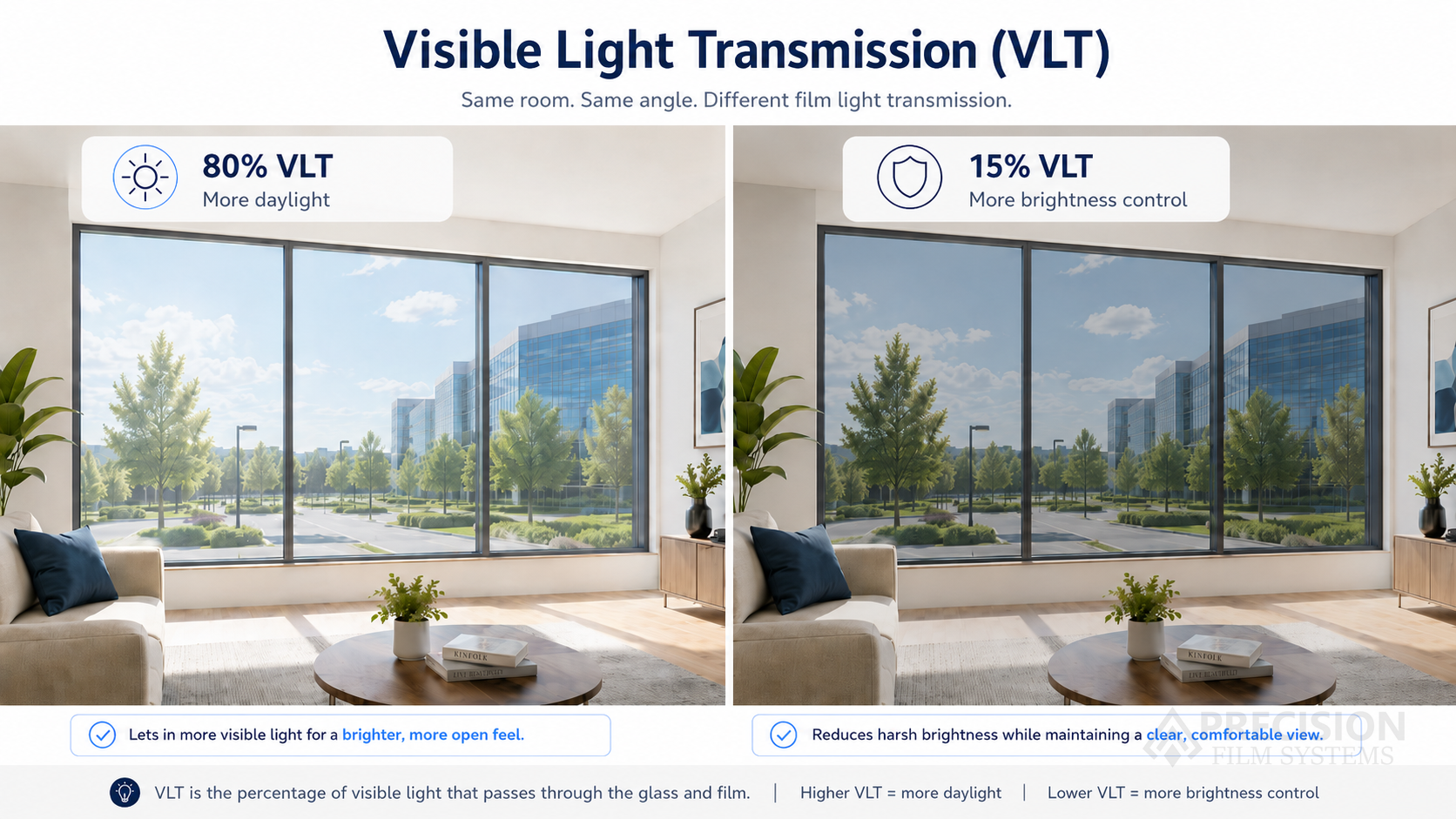
VLT stands for visible light transmission. It tells you how much visible light passes through the glass and window film.
A higher VLT lets more daylight through. A lower VLT lets less visible light through and usually makes the glass look darker.
For flat glass film work, VLT is one of the first numbers customers notice because it affects how the window looks and how bright the room feels. But VLT does not tell the whole story about heat, privacy, glare, or glass compatibility.
VLT in Plain English
Think of VLT as the "how much light gets through" number.
A film with 70% VLT allows a lot of visible light through and usually looks fairly light or neutral.
A film with 15% VLT allows much less visible light through and usually looks darker.
That number can help set expectations before installation. If a customer wants to keep the room feeling bright and open, a higher VLT film is usually the better direction. If the customer is trying to reduce harsh brightness or screen glare, a lower VLT film may be worth considering.
Why VLT Matters on Flat Glass Jobs
VLT affects several parts of the conversation:
- How dark the glass will look
- How much daylight the room keeps
- How much visible glare may be reduced
- Whether the film feels too dark from inside
- Whether the customer expects privacy
- How the finished job may look from outside
For installers and estimators, VLT is useful because it helps translate a spec sheet into a customer expectation. It gives you a simple way to explain why two films with similar heat claims may look very different once installed.
What VLT Does Not Tell You
VLT does not tell you total heat rejection by itself.
This is one of the most common misunderstandings in window film conversations. A darker film may reduce more visible brightness, but that does not automatically mean it is the best heat-control film for the job.
VLT also does not tell you:
- Total solar energy rejected
- Solar absorption
- SHGC
- IR rejection
- Exterior reflectance
- Interior reflectance
- Whether the film is safe for a specific glass type
- Whether the film is approved for a certain Low-E coating or insulated glass unit
A film can have a lower VLT and still need a closer look before it is recommended. The full spec sheet and the glass conditions matter.
Does Low VLT Create Glass Risk?
VLT by itself is not the risk number.
The concern is that some darker films may also absorb more solar energy, depending on the film construction. Higher absorption can matter on certain glass types, Low-E coatings, insulated glass units, shaded glass, or partially exposed windows.
That does not mean every low VLT film is a problem. It means you should not approve a film from VLT alone.
Before recommending a darker film, especially on flat glass, check the manufacturer's film-to-glass guidance and consider:
- Glass type
- Single pane vs insulated glass
- Low-E coatings
- Interior or exterior application
- Partial shade patterns
- Existing glass damage
- Edge conditions
- Sun exposure and orientation
For a customer, the simple explanation is this: darker does not automatically mean better, and it does not automatically mean safe for every window.
VLT and Glare
VLT is closely tied to glare because glare is usually caused by too much visible brightness.
A lower VLT film can reduce the amount of visible light entering the space, which may make screens easier to see and rooms more comfortable. This is why VLT is often part of the glare conversation.
But glare reduction still depends on the room, window direction, film choice, screen location, and the customer's expectations.
If a customer says, "I want to stop glare," the better follow-up is, "Where is the glare happening, and what are you trying to see more comfortably?"
VLT and Privacy
VLT can affect privacy, but it is not a privacy guarantee.
A darker film may make it harder to see through the glass in some conditions, but privacy also depends heavily on reflectance and lighting.
Daytime privacy usually works best when the outside is brighter than the inside. At night, when lights are on inside, that effect can change or reverse.
This is why customers should not be told that a low VLT film automatically gives privacy all the time.
How to Explain VLT to a Customer
A simple way to explain VLT is:
"VLT tells us how much visible light the film lets through. Lower numbers look darker and reduce more brightness. Higher numbers keep the room brighter. But VLT is only one part of the spec sheet, so we still need to look at heat performance, reflectance, absorption, and whether the film is right for your glass."
That keeps the explanation accurate without turning the conversation into an engineering lesson.
Installer Takeaway
VLT is one of the most useful spec numbers for setting appearance and brightness expectations.
Use it to explain how light or dark the film may feel. Use it when talking about glare and daylight. But do not use VLT by itself to judge heat performance, privacy, or compatibility.
For flat glass jobs, VLT starts the conversation. It should not finish it.
Related Terms
- TSER
- IR Rejection
- UV Rejection
- SHGC
- Glare Reduction
- Visible Reflectance
- Daytime Privacy
- Solar Absorption
- Film-to-Glass Compatibility
Sources and further reading
- 2026 Flat Glass Solar Education Guide - International Window Film Association Industry education defining visible light transmission and relating it to glass, film construction, reflectance, glare, and privacy.
- 2026 Advanced Solar Control Education Guide - International Window Film Association Advanced reference for interpreting visible-light and solar-control values within the complete glazing system.
VLT on a window film spec sheet
What does VLT stand for in window film?
VLT stands for visible light transmission. It describes how much visible light passes through the glass and window film.
Is a lower VLT always better?
No. Lower VLT usually means a darker film and more brightness control, but the right number depends on daylight, glare, appearance, privacy expectations, heat goals, and the glass system.
Does VLT tell you heat rejection?
No. VLT describes visible light transmission, not total heat performance. Heat conversations should also consider TSER, SHGC, absorption, reflectance, IR rejection, glass type, exposure, and manufacturer guidance.
Does low VLT create glass risk?
VLT by itself is not the risk number. Some darker films may also absorb more solar energy depending on construction, so darker film choices should be checked against the glass type, Low-E coatings, IGUs, shade patterns, and manufacturer film-to-glass guidance.
Does low VLT guarantee privacy?
No. VLT can affect how easy it is to see through glass, but privacy also depends on reflectance and lighting conditions. Daytime privacy can change or reverse at night when the inside is brighter than the outside.