
Visible reflectance describes how much visible light reflects off the glass and film surface.
On a window film spec sheet, you may see reflectance listed as interior reflectance, exterior reflectance, or simply visible reflectance.
These numbers affect how the film looks from inside and outside. They also affect customer expectations around privacy, glare, nighttime appearance, and how mirror-like the finished glass may look.
Reflectance in Plain English
Reflectance is the amount of light bouncing off a surface.
A higher reflectance number usually means the glass may look more reflective or mirror-like.
A lower reflectance number usually means the glass may look more neutral or less reflective.
In flat glass work, reflectance is not just a technical number. It can change how the building looks after installation and how the customer feels about the view from inside.
Interior vs Exterior Reflectance
Interior reflectance and exterior reflectance are measured from different sides of the glass.
| Spec term | Plain-English meaning |
|---|---|
| Interior reflectance | How reflective the glass may look from inside the room |
| Exterior reflectance | How reflective the glass may look from outside the building |
A film can have different reflectance values on each side. This is common with dual-reflective films, where the exterior side may be more reflective than the interior side.
That can help reduce the mirror effect from inside while still giving the outside a more reflective appearance.
Why Exterior Reflectance Affects Appearance
Exterior reflectance affects how the glass looks from the street, parking lot, sidewalk, or neighboring property.
A higher exterior reflectance may make the glass look more silver, mirrored, or noticeable. That can be a good fit when the customer wants daytime privacy or a more reflective building appearance.
It can also be a problem if the customer wants a subtle look.
Before recommending a highly reflective film, check whether the exterior appearance could create issues with:
- Storefront visibility
- HOA or property rules
- Building design preferences
- Neighboring windows
- Customer expectations
- Existing glass that needs to match other elevations
A film can perform well on paper and still be the wrong visual fit for the building.
Exterior Reflection and Nearby Surfaces
Exterior reflectance can also affect what the sun bounces onto after it leaves the glass.
On some jobs, reflected sunlight may land on artificial turf, vinyl siding, painted surfaces, patio furniture, neighboring windows, or other heat-sensitive materials. The risk depends on the glass angle, sun path, season, time of day, film reflectance, distance to the surface, and how long the reflection stays in one spot.
This should not be treated as a common problem on every reflective film job. It is still worth checking when the glass faces turf, nearby siding, close neighboring structures, or materials that already get hot in direct sun.
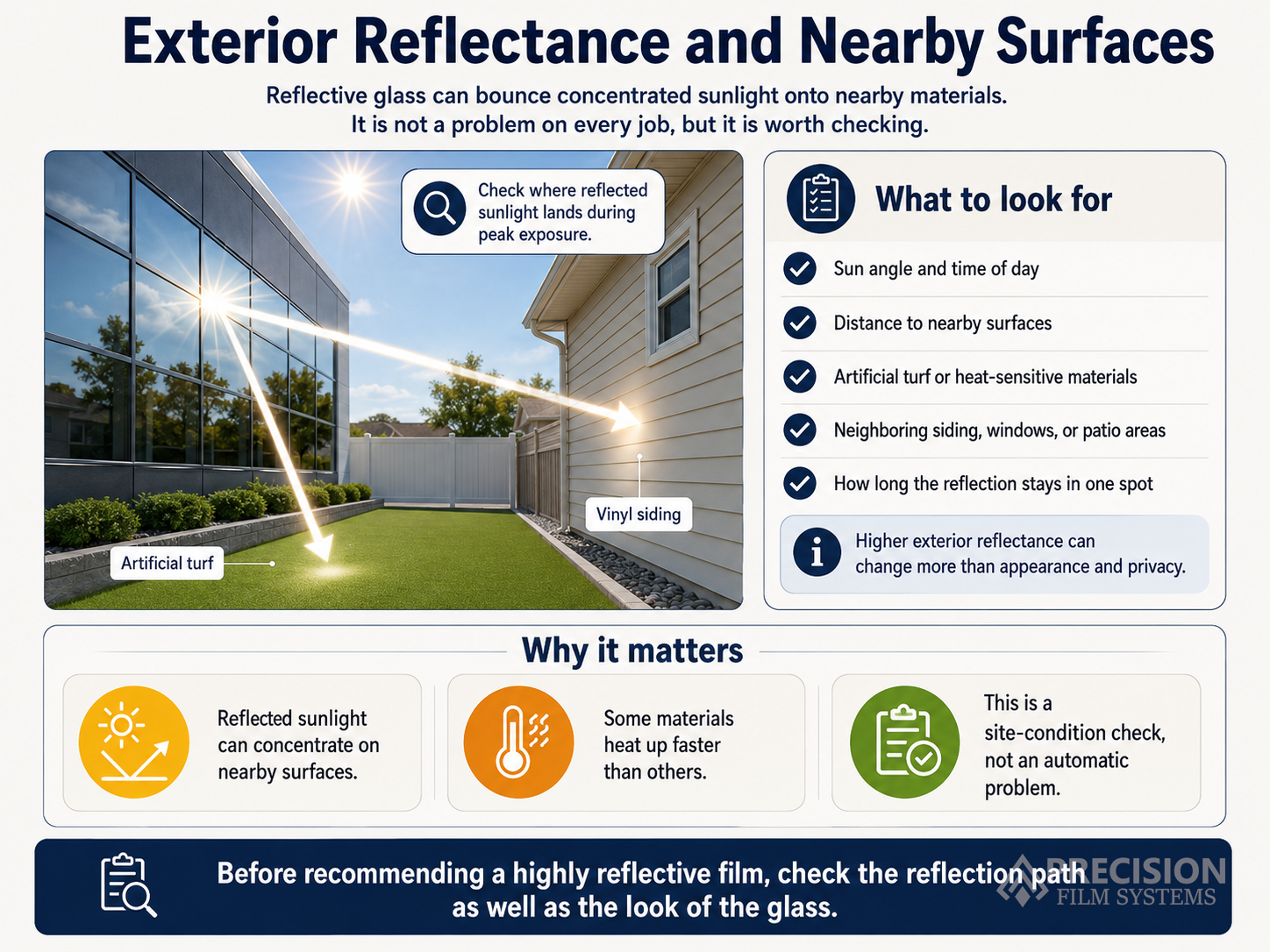
A simple field check is to look where the reflected sun is landing during the strongest exposure window. If the reflection is concentrated on a sensitive surface, the exterior appearance conversation may need to include more than privacy and glare.
Why Interior Reflectance Affects the View
Interior reflectance affects what the customer sees from inside.
A higher interior reflectance can create more mirror-like reflection on the room side, especially at night when the lights are on.
That can bother customers who want a clear view out after dark. They may see more of the room reflected back at them instead of the outside view.
Lower interior reflectance can help keep the view more comfortable from inside, depending on the film, glass, and lighting conditions.
This is one reason dual-reflective films are often discussed for flat glass jobs. The goal is often to get stronger exterior performance or appearance without making the interior side feel as reflective.
Reflectance and Daytime Privacy
Reflectance can help with daytime privacy, but it does not create privacy in every condition.
Reflective privacy depends heavily on lighting.
When the outside is brighter than the inside, a reflective film can make it harder to see into the building from outside.
When the inside is brighter than the outside, that effect can weaken or reverse.
This is where customers often get the wrong idea. A film that gives privacy during the day may not give the same privacy at night.
Reflectance and Glare
Reflectance can affect glare, but it should not be treated as the only glare number.
Glare is tied closely to visible light, window direction, sun angle, room layout, screen placement, and film selection.
A reflective film may reduce some harsh visible light entering the room, but the customer's actual glare problem still needs to be understood.
A conference room with screen glare may need a different recommendation than a storefront, a lobby, or a home office.
Reflectance and Glass Risk
Reflectance by itself is not usually the glass-risk number.
Compatibility questions usually come from the full glass and film system: solar absorption, glass type, Low-E coatings, insulated glass units, partial shading, existing damage, edge condition, and manufacturer guidance.
Reflective films can still deserve a closer look depending on the glass and job conditions. Do not use exterior reflectance, appearance, or privacy goals as a shortcut around the film-to-glass check.
What to Check Before Recommending a Reflective Film
Before recommending a film with higher reflectance, check both sides of the job.
From outside:
- How will the building look from the street?
- Does the customer want a mirrored appearance?
- Does the film need to match other glass?
- Are there HOA, property, or design restrictions?
- Will storefront visibility be affected?
- Could reflected sunlight land on turf, vinyl siding, painted surfaces, or other heat-sensitive materials?
From inside:
- Does the customer care about the nighttime view?
- Are interior lights on after dark?
- Is the room used for screens, meetings, or displays?
- Will interior reflection bother the customer?
- Is privacy expected during the day, night, or both?
Those questions help keep the recommendation tied to the actual use of the space.
How to Explain Reflectance to a Customer
A simple explanation is:
"Reflectance tells us how much light reflects off the glass. Exterior reflectance affects how the building looks from outside. Interior reflectance affects how much reflection you may see from inside, especially at night. Reflective film can help with daytime privacy, but privacy changes when the lighting changes."
That gives the customer the useful part without overpromising privacy.
Installer Takeaway
Reflectance is mostly an appearance and expectation-setting number.
Use it when the customer cares about privacy, glare, exterior appearance, or nighttime view.
Do not treat reflectance as a full performance number by itself. Compare it with VLT, TSER, SHGC, absorption, glass type, and the customer's actual goal.
For flat glass jobs, reflectance can help sell the right film. It can also create callbacks if the customer expected one-way privacy or a clear nighttime view and did not get that explained before installation.
Related Terms
- VLT
- Daytime Privacy
- Nighttime Privacy
- Glare Reduction
- Dual-Reflective Film
- TSER
- Solar Absorption
- Film-to-Glass Compatibility
Sources and further reading
- 2026 Flat Glass Solar Education Guide - International Window Film Association Industry education on visible light, reflectance, glazing, surface appearance, and film-performance values.
- ASTM E903-20 - Solar Absorptance, Reflectance, and Transmittance Official test-method page for spectral measurement of material reflectance and transmittance.
Reflectance on a window film spec sheet
What does visible reflectance mean on a window film spec sheet?
Visible reflectance describes how much visible light reflects off the glass and film surface. Higher visible reflectance usually makes the finished glass look more reflective or mirror-like.
Why do spec sheets list interior and exterior reflectance separately?
Interior reflectance describes how reflective the glass may look from inside the room. Exterior reflectance describes how reflective it may look from outside the building. Some films have different reflectance values on each side.
Does reflective window film guarantee privacy?
No. Reflective privacy depends heavily on lighting. Daytime privacy can work differently from nighttime privacy when the inside is brighter than the outside.
Can exterior reflectance affect nearby surfaces?
On some jobs, reflected sunlight may land on turf, vinyl siding, painted surfaces, neighboring windows, or other heat-sensitive materials. This is a site-condition check, not an automatic problem on every reflective film job.
Is reflectance the same thing as a glass compatibility check?
No. Reflectance is mostly an appearance and expectation-setting number. Compatibility still depends on the glass and film system, including absorption, glass type, Low-E coatings, insulated glass units, shading, existing damage, and manufacturer guidance.