
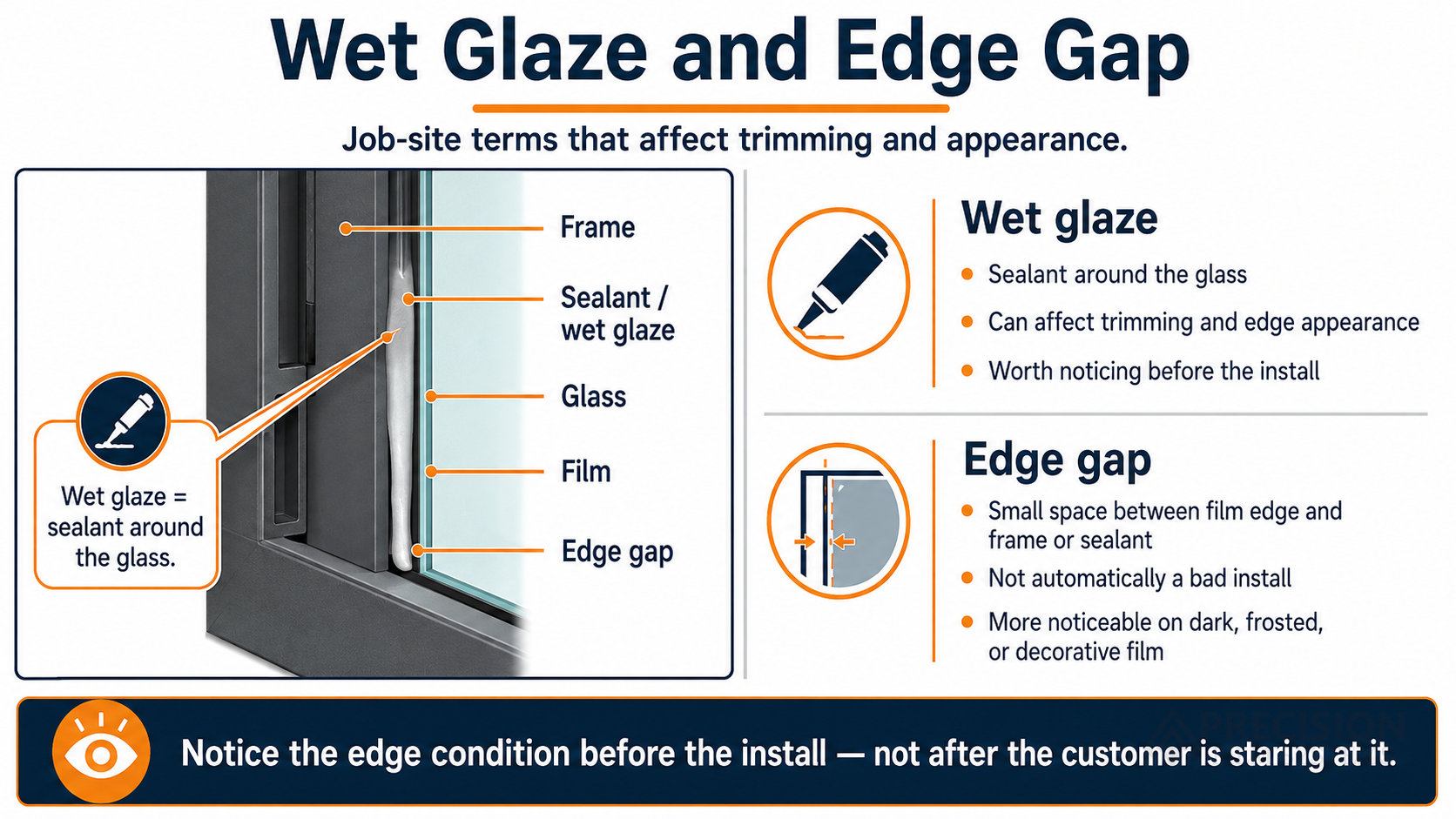
Some important flat glass terms do not come from the film spec sheet.
Wet glaze, edge gap, frames, gaskets, sealant, exposed edges, old film, bad caulk lines, chips, cracks, and dirty edges all come from the job site.
Those details can affect the install, quote, prep, trimming, appearance, and customer expectations.
Wet Glaze
Wet glaze usually means there is sealant around the glass.
That does not automatically make the job a problem. It means the edge condition needs attention.
Sealant can affect trimming, cleaning, contamination risk, drying, and how the finished edge looks.
Old, soft, messy, failing, or smeared sealant should be noted before installation.
Edge Gap
Edge gap is the small space between the film edge and the frame, gasket, sealant, or glass edge.
Customers usually do not think about edge gap until they are looking closely at the finished glass.
Edge gap can be more noticeable on dark film, frosted film, decorative film, interior glass, entry doors, sidelites, storefronts, and glass people stand close to.
A small edge gap is not automatically a bad install. In many cases, the film needs to be trimmed slightly away from the edge condition so it can lay cleanly.
Why Edges Matter
The edge condition can change the job.
Tight frames, rubber gaskets, wet glaze, old sealant, dirt packed into the edge, existing film adhesive, chips, cracks, failed seals, exposed glass edges, smeared caulk, and awkward stops can all affect the finished work.
These details can affect labor, prep, appearance, customer expectations, and whether a closer review is needed.
Wet Glaze Is Not Glass Compatibility
Wet glaze is an edge or glazing condition.
It is not the same as Low-E, absorption, or thermal stress.
Still, questionable edge conditions should be noted along with the rest of the glass review. Damaged glass, failed seals, unknown Low-E, partial shade, large panes, and high-absorption film should all slow the recommendation down.
Use the glass and film compatibility checklist for the broader glass-system review.
What to Write Down
Good field notes may include:
- Wet glaze present
- Messy or damaged sealant
- Exposed edges
- Existing chips or cracks
- Failed seal concerns
- Old film or adhesive
- Tight frames
- Dirty edge conditions
- Decorative film edge visibility
- Customer-sensitive sightlines
- Areas where the edge gap may be noticeable
This information is easy to lose if the job is only recorded as width and height.

Customer Explanation
The condition around the edge of the glass can affect how the film is trimmed and how the finished edge looks. If there is sealant, tight framing, old adhesive, or damaged edges, we need to account for that before installation.
Installer Notes
Notice the edge conditions before quoting or installing.
Write down anything that may affect prep, trimming, appearance, compatibility review, or customer expectations.
Do not wait until the customer is inspecting the finished glass to explain an edge condition that was visible during the quote.
Related Terms
Source and further reading
- Architectural Visual Inspection Guideline for Applied Window Film - International Window Film Association Guidance on viewing conditions, drying-related appearance, edge gaps, splices, and inspection of applied architectural window film.
Installation details and acceptable edge conditions can vary by product and system. Confirm the current manufacturer instructions for the exact film and attachment method.
Wet glaze and edge gap
What does wet glaze mean?
Wet glaze usually means sealant is used around the glass.
What is an edge gap?
Edge gap is the small space between the film edge and the frame, gasket, sealant, or edge condition.
Is an edge gap a bad install?
Not by itself. A small edge gap may be part of a clean installation depending on the frame and edge condition.
Why should edge conditions be noted before the job?
They can affect trimming, prep, appearance, labor, and customer expectations.