
UV rejection tells you how much ultraviolet energy a window film rejects.
Most architectural window films list very high UV rejection numbers. A spec sheet may show 99% UV rejection, and that is a useful number. It just needs to be explained correctly.
UV rejection helps with UV exposure and fading conversations, but it does not mean the film prevents all fading. It also does not explain heat control, glare reduction, privacy, or glass compatibility by itself.
UV in Plain English
UV stands for ultraviolet.
UV is one part of the sun's energy. You cannot see it, but it contributes to fading, material damage, and UV exposure concerns.
When a window film says it rejects 99% of UV, it means the film is rejecting most of the ultraviolet energy in the measured range.
That is a real benefit. It should not be stretched into claims the spec does not support.
What UV Rejection Helps With
UV rejection is useful when the customer is concerned about:
- Fading furniture
- Protecting floors
- Reducing UV exposure
- Protecting merchandise in storefronts
- Slowing damage to fabrics, artwork, displays, and interior finishes
For installers and estimators, UV rejection is usually easy to explain. The customer already understands that sunlight can damage materials over time. The spec gives you a way to show that film can reduce one major source of that damage.
UV Rejection Is Not Complete Fade Prevention
Fading is not caused by UV alone.
UV is a major contributor, but visible light, solar heat, material quality, dye stability, humidity, and normal aging can also affect fading.
So a film with 99% UV rejection can help reduce fading risk, but it should not be sold as complete fade prevention.
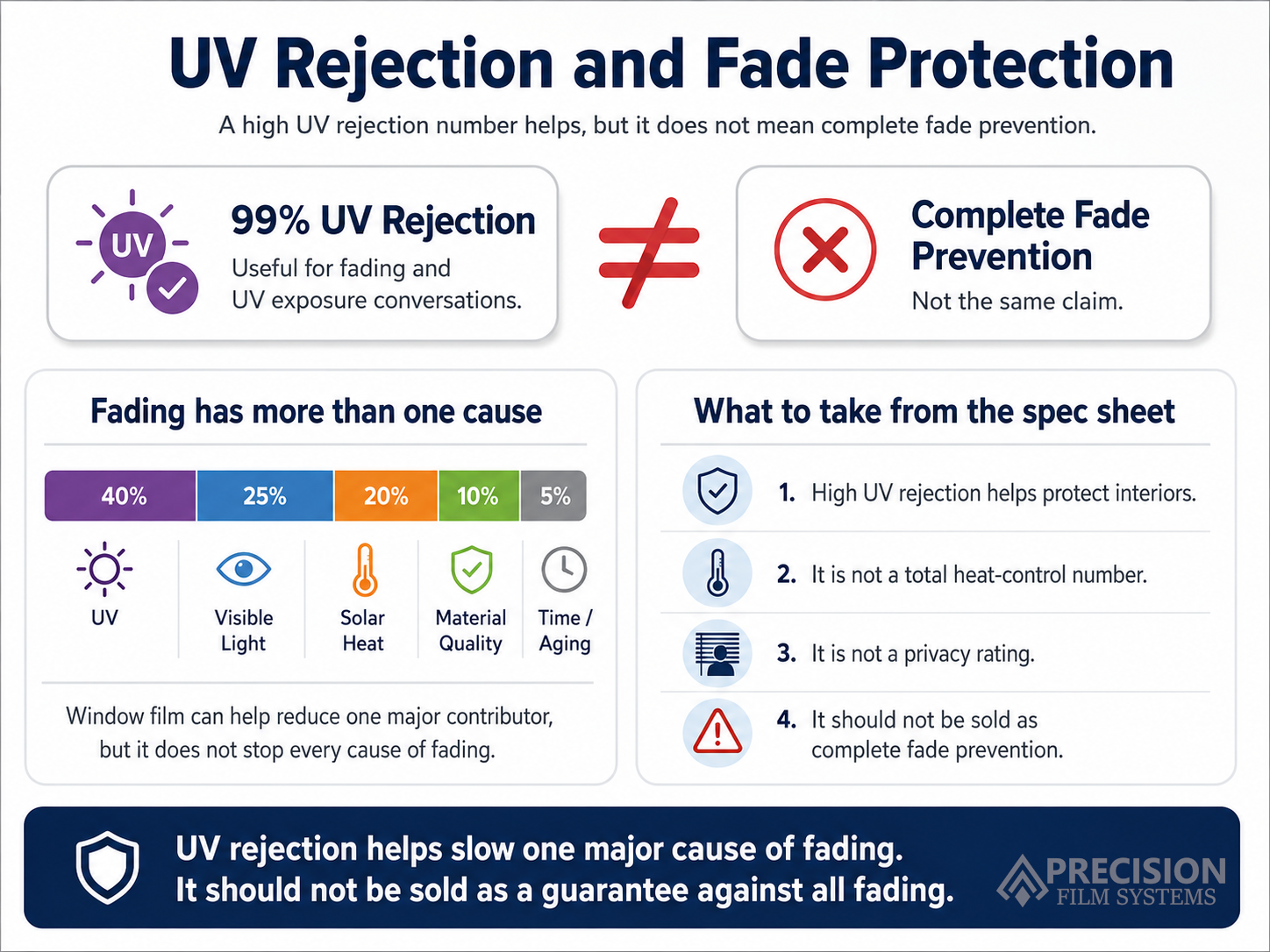
A cleaner customer explanation is:
"Window film can block most UV, which helps slow one major cause of fading. It does not stop every cause of fading."
That is more accurate than promising the customer their flooring, furniture, or merchandise will not fade.
UV Rejection Is Not Heat Rejection
A high UV rejection number does not mean high heat rejection.
UV is only a small portion of the total solar energy reaching the glass. A film can reject 99% of UV and still have a much lower TSER number because TSER includes ultraviolet, visible light, and infrared energy.
If the customer's main issue is heat, look beyond UV rejection.
Check:
- TSER
- SHGC
- IR rejection
- VLT
- Solar absorption
- Reflectance
- Glass type and exposure
UV rejection belongs in the performance conversation, but it is not the heat-control number.
UV Rejection and Glass Risk
UV rejection by itself is not usually where flat glass risk comes from.
Compatibility concerns usually come from the full glass and film system: absorption, glass type, coatings, insulated glass units, partial shading, existing damage, edge condition, and manufacturer guidance.
A film can have excellent UV rejection and still need a closer look if the glass has Low-E coatings, heavy shade patterns, or other compatibility concerns.
Do not use UV rejection as a shortcut for film-to-glass approval.
What to Take From the Spec Sheet
| Spec-sheet claim | Useful takeaway | Do not turn it into |
|---|---|---|
| High UV rejection | Helps explain protection from a major fading contributor. | A promise that fading will stop. |
| 99% UV rejection | Shows strong UV reduction in the measured range. | 99% total heat rejection. |
| UV protection | Supports UV exposure and interior-protection conversations. | A privacy rating, glare rating, or glass approval. |
What to Check Before Using UV as the Selling Point
If UV protection is the customer's main concern, ask what they are trying to protect.
A storefront with merchandise may need a different conversation than a homeowner worried about hardwood floors. Artwork, fabrics, flooring, and product displays all age differently.
Also check whether the customer expects the film to stop fading completely. That expectation should be corrected before the quote is approved.
Good follow-up questions include:
- What are you trying to protect from fading?
- Is the area exposed to direct sun for long periods?
- Are you also concerned about heat or glare?
- Do you want to keep the room bright?
- Are there Low-E coatings or insulated glass units involved?
Those questions keep the recommendation tied to the job instead of one spec number.
How to Explain UV Rejection to a Customer
A simple explanation is:
"UV rejection tells us how much ultraviolet energy the film rejects. Most window films block a very high amount of UV, which helps slow one major cause of fading. Fading can still happen from visible light, heat, material quality, and normal aging, so UV rejection should not be described as complete fade prevention."
That gives the customer the benefit without overselling it.
Installer Takeaway
UV rejection is useful, especially when the customer is worried about fading or UV exposure.
Use the number honestly. It helps explain protection from one part of the sun's energy.
Do not use it as a heat claim. Do not use it as a privacy claim. Do not use it as a compatibility claim. Do not promise that fading will stop.
For flat glass jobs, UV rejection should be read with the rest of the spec sheet and the actual conditions at the window.
Related Terms
- TSER
- VLT
- IR Rejection
- Solar Heat Gain Coefficient
- Glare Reduction
- Solar Absorption
- Film-to-Glass Compatibility
Source and further reading
- 2026 Flat Glass Solar Education Guide - International Window Film Association Industry education on ultraviolet wavelengths, ultraviolet transmittance, fading factors, glass, and film-performance terminology.
UV rejection on a window film spec sheet
What does UV rejection mean in window film?
UV rejection describes how much ultraviolet energy the window film rejects in the measured range. Most architectural films list very high UV rejection, often around 99%.
Does 99% UV rejection mean no fading?
No. High UV rejection can help slow one major cause of fading, but fading can also come from visible light, solar heat, material quality, dye stability, humidity, and normal aging.
Is UV rejection the same as heat rejection?
No. UV rejection is not the total heat-control number. Heat conversations should also consider TSER, SHGC, IR rejection, VLT, absorption, reflectance, glass type, exposure, and manufacturer guidance.
Does UV rejection decide film-to-glass compatibility?
Usually no. Film-to-glass compatibility depends on the full glass and film system, including absorption, glass type, coatings, insulated glass units, partial shading, existing damage, edge condition, and manufacturer guidance.
What should I compare with UV rejection?
Compare UV rejection with TSER, SHGC, IR rejection, VLT, solar absorption, reflectance, glass type, exposure, customer goals, and any manufacturer film-to-glass guidance.