
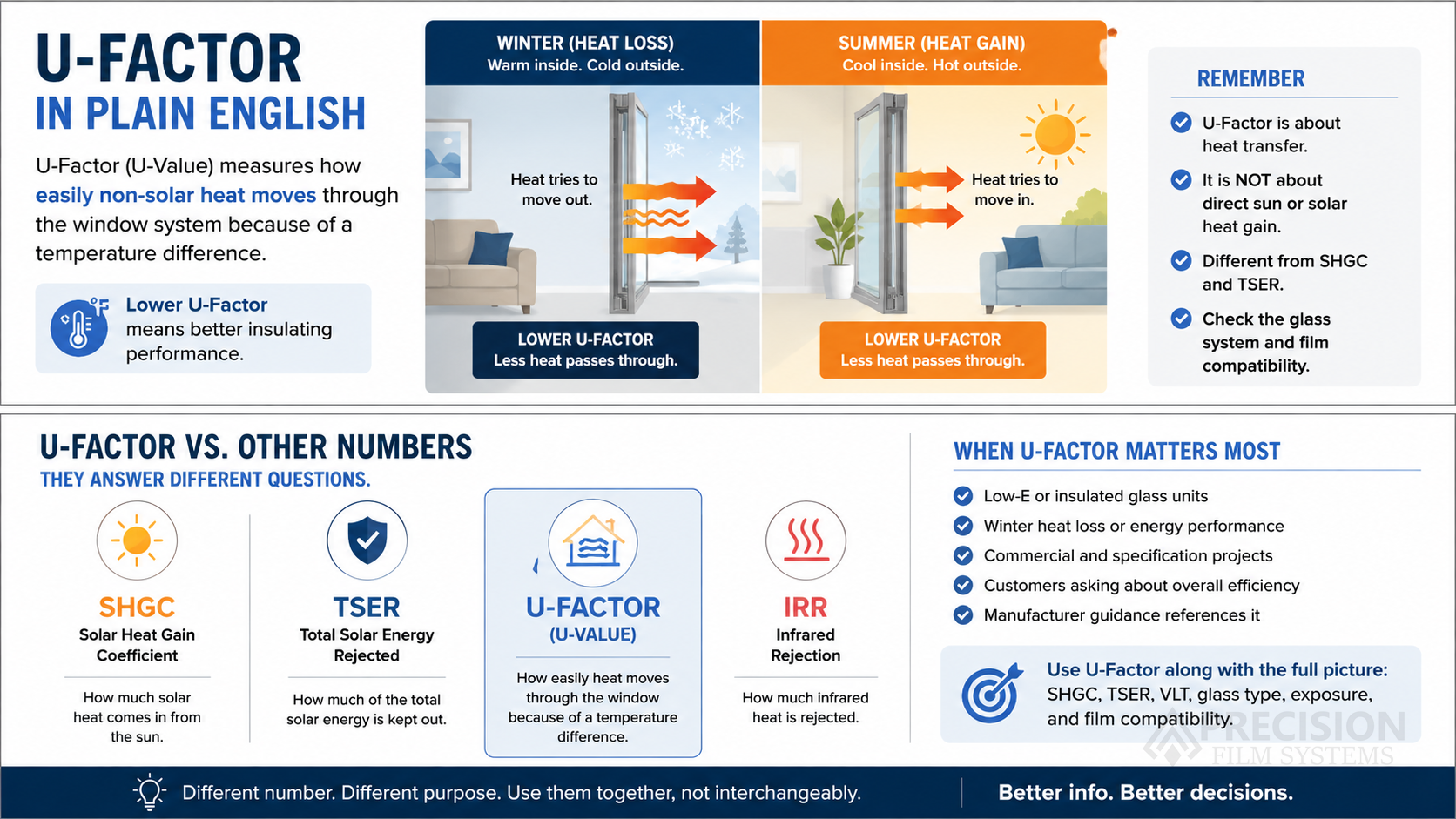
U-Factor is about heat moving through the window system because of a temperature difference between inside and outside.
A lower U-Factor usually means better insulating performance.
Do not use U-Factor like it means solar heat rejection. It is not the same as SHGC, TSER, IR rejection, or visible darkness.
What U-Factor Means
U-Factor measures how easily heat moves through the window system.
If it is cold outside and warm inside, U-Factor is part of the conversation about heat moving out through the glass. If it is hot outside and cool inside, it is part of the conversation about heat moving in.
That is different from direct sun hitting the glass.
A plain customer explanation:
U-Factor is more about heat transfer through the window. SHGC is more about solar heat coming from the sun.
Where It Gets Mixed Up
A customer may say they want to reduce heat. The next question is what kind of heat problem they are having.
A west-facing office getting hot every afternoon is usually a solar heat conversation.
A room that feels cold near the glass in winter may involve U-Factor, glass type, Low-E, drafts, window construction, and the building itself.
Those are not the same problem.
Why It Comes Up With Low-E Glass
Low-E coatings affect heat transfer. U-Factor often shows up in Low-E and insulated glass conversations.
Not all Low-E glass is the same. The coating location, glass package, pane size, exposure, and manufacturer guidance can change the film recommendation.
When Low-E or insulated glass is involved, do not jump straight to a heat-rejection claim. Check the glass system first.
Use the window film specification guide to keep U-Factor, SHGC, TSER, and other values in their proper context.
What U-Factor Does Not Tell You
U-Factor does not tell you how dark the film looks.
It does not tell you how much glare will be reduced.
It does not approve a film for a specific Low-E unit.
It does not predict whether a hot room will feel comfortable after install.
It does not replace SHGC, TSER, absorption, reflectance, exposure notes, or manufacturer guidance.
Customer Explanation
U-Factor is about heat moving through the window because one side is warmer than the other. It is more of an insulation number. For direct sun heat, we also need to look at SHGC, TSER, glass type, and sun exposure.
Installer Notes
Pay attention to U-Factor when Low-E glass, insulated glass units, commercial specs, winter comfort, or energy performance comes up.
For a basic glare or direct-sun heat job, U-Factor is usually not the lead number.
Do not use U-Factor interchangeably with SHGC or TSER.
Related Terms
- Low-E
- Emissivity
- SHGC
- TSER
- Insulated Glass Unit
- Solar Heat Gain
- Film-to-Glass Compatibility
Sources and further reading
- 2026 Advanced Solar Control Education Guide - International Window Film Association Advanced reference on heat transfer, glazing systems, emissivity, U-Factor, and solar-control measurements.
- Window Film Ratings and Certification - National Fenestration Rating Council Independent overview of certified window-film energy ratings and labels.
U-Factor and Window Film FAQs
What does U-Factor mean?
U-Factor describes how easily heat moves through the window system because of a temperature difference between inside and outside.
Is lower U-Factor better?
Usually yes. A lower U-Factor means the window system resists heat transfer better.
Is U-Factor the same as heat rejection?
No. U-Factor is more about heat transfer through the window. Solar heat conversations usually involve SHGC, TSER, IR rejection, absorption, and reflectance.
Why does U-Factor matter with Low-E glass?
Low-E coatings affect heat transfer, so U-Factor may be part of understanding the glass system. Manufacturer guidance still needs to be checked before choosing film.