
Total solar absorbance, reflectance, and transmittance describe what happens to solar energy when it reaches the glass and film system.
In plain English:
- Total solar absorbance is the portion taken in by the glass and film system.
- Total solar reflectance is the portion reflected away.
- Total solar transmittance is the portion that passes through.
Some technical references use the word absorptance. On many film spec sheets, installers are more likely to see absorbance or % total solar absorbance. This article uses the spec-sheet language an installer is likely to run into.
The Simple Way to Think About It
When sunlight hits a filmed window, the solar energy has three basic paths.
Some of it reflects away from the glass. Some of it passes through the glass into the room. Some of it gets absorbed by the glass and film system.
| Spec term | Plain-English meaning | Job conversation |
|---|---|---|
| Total solar reflectance | Solar energy reflected away | Appearance, exterior reflection, privacy, solar control |
| Total solar transmittance | Solar energy passing through | Heat gain, daylight, glare, comfort |
| Total solar absorbance | Solar energy taken into the glass and film system | Glass temperature, compatibility, thermal stress concerns |
These numbers help explain why two films can look similar but behave differently on the glass.
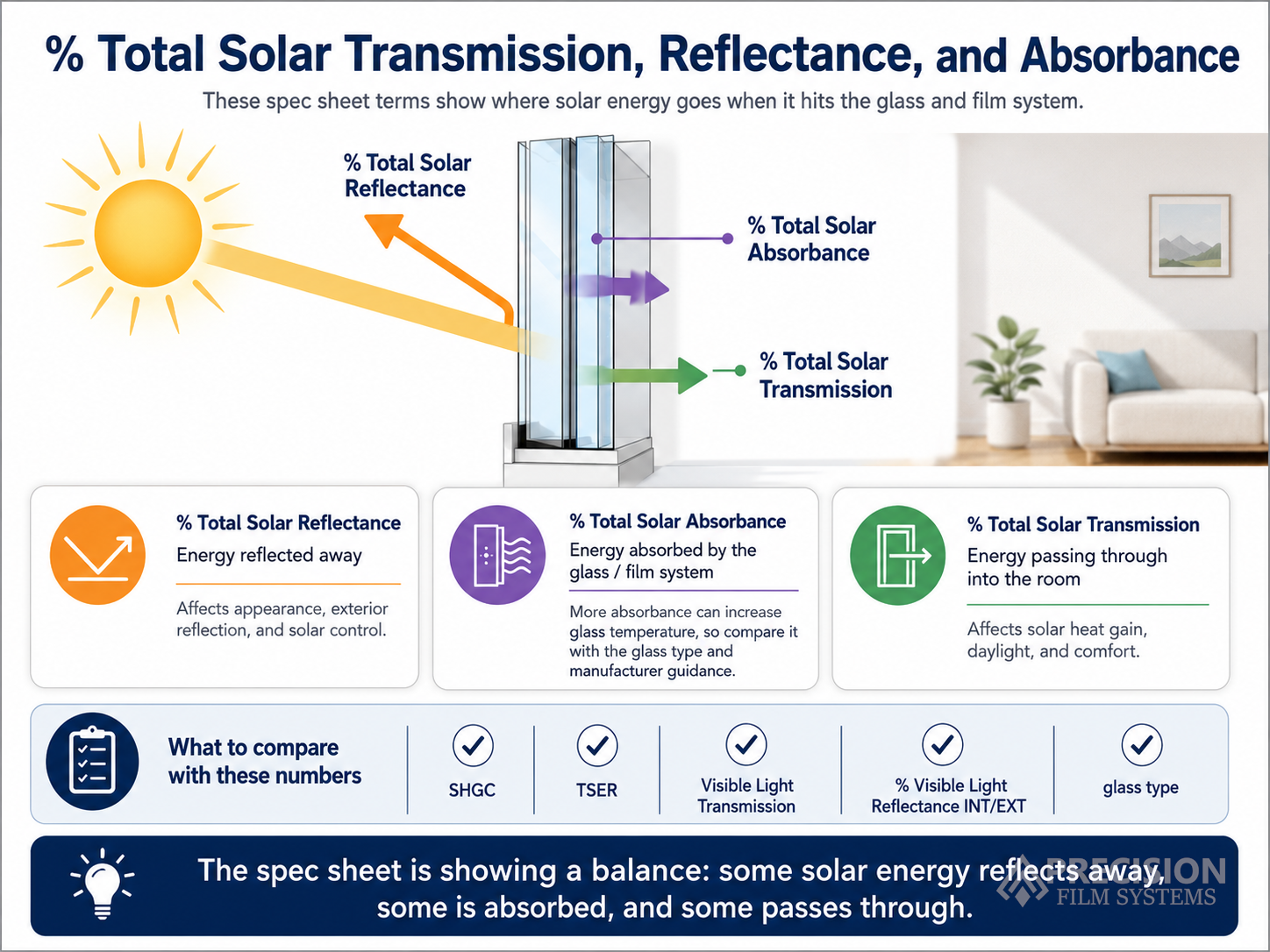
Total Solar Absorbance
Total solar absorbance describes how much solar energy is absorbed by the glass and film system.
For flat glass installers, this is one of the numbers worth slowing down on because absorbed energy can raise glass temperature.
A higher absorbance number does not automatically make a film unsafe. It does mean the glass conditions need a closer look.
Absorbance can become part of the compatibility conversation when the job involves:
- Insulated glass units
- Low-E coatings
- Tinted glass
- Laminated glass
- Large panes
- Partial shade
- Existing glass damage
- Unusual edge conditions
- Strong sun exposure
If a film absorbs a lot of solar energy, the next question is whether that film is approved for the specific glass and exposure.
Total Solar Reflectance
Total solar reflectance describes how much solar energy is reflected away from the glass and film system.
Reflectance can affect both performance and appearance.
From the customer's side, reflectance often shows up as:
- A more mirrored exterior look
- Stronger daytime privacy in some conditions
- A different building appearance
- More interior reflection at night
- Possible reflected sunlight onto nearby surfaces
Reflectance can reduce the amount of solar energy entering the system, but it also changes how the glass looks. A highly reflective film may fit one building and look too noticeable on another.
Reflective glass can also bounce sunlight onto nearby materials. Artificial turf, vinyl siding, painted surfaces, patio furniture, neighboring windows, or close structures may need a closer look if reflected sunlight stays concentrated in one spot during peak exposure.
Total Solar Transmittance
Total solar transmittance describes how much solar energy passes through the glass and film system. Some spec sheets may use the phrase total solar transmission for the same kind of conversation.
Visible light transmission, or VLT, is one type of transmission number, but it only deals with visible light.
Total solar transmittance is broader. It looks at solar energy passing through, not just the visible part of the spectrum.
For customer conversations, transmittance usually connects to:
- How bright the room feels
- How much glare enters the room
- How much solar energy still passes through
- How much view or daylight the customer keeps
A film with lower visible transmission will usually look darker. A film with lower total solar transmittance may reduce more solar energy entering the room.
Those are related, but they are not the same spec.
Why Absorbance Connects to Glass Risk
Total solar absorbance is usually the number that deserves the closest compatibility review.
When more solar energy is absorbed by the glass and film system, glass temperature can rise. That can create more concern on certain glass types, coatings, insulated glass units, shaded panes, or damaged glass.
Reflectance and transmittance still belong in the conversation, but absorbance is often where installers start looking harder at manufacturer guidance.
Before recommending a film, especially on flat glass, compare these specs with:
- Glass type
- Low-E surfaces
- Single pane vs insulated glass
- Interior vs exterior installation
- Partial shade
- Pane size
- Existing damage
- Edge condition
- Manufacturer film-to-glass charts
Do not use absorbance by itself as an approval or rejection. Use it as a reason to check the full glass and film system.
How These Terms Connect to TSER and SHGC
TSER and SHGC are easier to understand when you know absorbance, reflectance, and transmittance.
TSER describes total solar energy rejected.
SHGC describes how much solar heat gain enters through the window system.
Absorbance, reflectance, and transmittance help explain how the system gets there.
A film might reject more energy by reflecting more away. Another film might reduce transmission but absorb more energy in the glass. Another may balance appearance, transmission, and absorbance differently.
The final film choice should come from the full spec sheet and the job conditions, not one number pulled out of context.
What to Compare With These Numbers
Absorbance, reflectance, and transmittance are most useful when they are read beside the rest of the spec sheet and the job conditions.
| Compare with | Why it matters |
|---|---|
| SHGC | Shows how much solar heat gain is admitted through the system |
| TSER | Shows the total solar energy rejected under the tested condition |
| Visible light transmission | Shows how much visible daylight passes through |
| Visible light reflectance | Shows how reflective the glass may look from one side or both sides |
| Glass type | Controls whether the film and glass combination needs closer compatibility review |
How to Explain It to a Customer
A simple explanation is:
"When sunlight hits the glass, some energy reflects away, some passes through, and some gets absorbed by the glass and film. The spec sheet helps us see that balance. Absorbance is one reason we check the film against the glass type before recommending it."
That keeps the explanation practical without turning the conversation into a physics lesson.
Installer Takeaway
Total solar absorbance, reflectance, and transmittance explain where solar energy goes at the window.
Use them when comparing films that look similar but perform differently. Use them when checking heat control, appearance, glare, privacy, and compatibility.
For flat glass work, total solar absorbance deserves the most caution because it connects directly to glass temperature and film-to-glass review.
The best recommendation is not the film with the biggest single performance number. It is the film that fits the glass, the exposure, the customer's appearance goals, and the performance target.
Related Terms
- TSER
- SHGC
- VLT
- Visible Reflectance
- Total Solar Absorbance
- IR Rejection
- Low-E
- Film-to-Glass Compatibility
Sources and further reading
- 2026 Flat Glass Solar Education Guide - International Window Film Association Industry education explaining how solar energy can be reflected, absorbed, or transmitted through a glazing system.
- ASTM E903-20 - Solar Absorptance, Reflectance, and Transmittance Official test-method page for measuring spectral absorptance, reflectance, and transmittance with integrating spheres.
Total solar absorbance, reflectance, and transmittance
What do total solar absorbance, reflectance, and transmittance mean?
They describe where solar energy goes when it reaches the glass and film system. Some energy is absorbed by the glass and film, some reflects away, and some passes through into the room.
Is absorbance the same as absorptance on a window film spec sheet?
Technical references often use absorptance, while many film spec sheets use absorbance or percent total solar absorbance. In practical installer conversations, the important point is how much solar energy is taken into the glass and film system.
Does high total solar absorbance mean a film is unsafe?
No. A higher absorbance number does not automatically make a film unsafe. It means the glass type, exposure, Low-E surfaces, insulated glass units, shade patterns, pane condition, and manufacturer guidance need a closer review.
Is total solar transmittance the same as VLT?
No. VLT describes visible light transmission. Total solar transmittance is broader because it refers to solar energy passing through the system, not only the visible portion of the spectrum.
What should these numbers be compared with?
Compare total solar absorbance, reflectance, and transmittance with TSER, SHGC, VLT, visible light reflectance, glass type, film-to-glass guidance, shade, exposure, and the customer's appearance and comfort goals.