
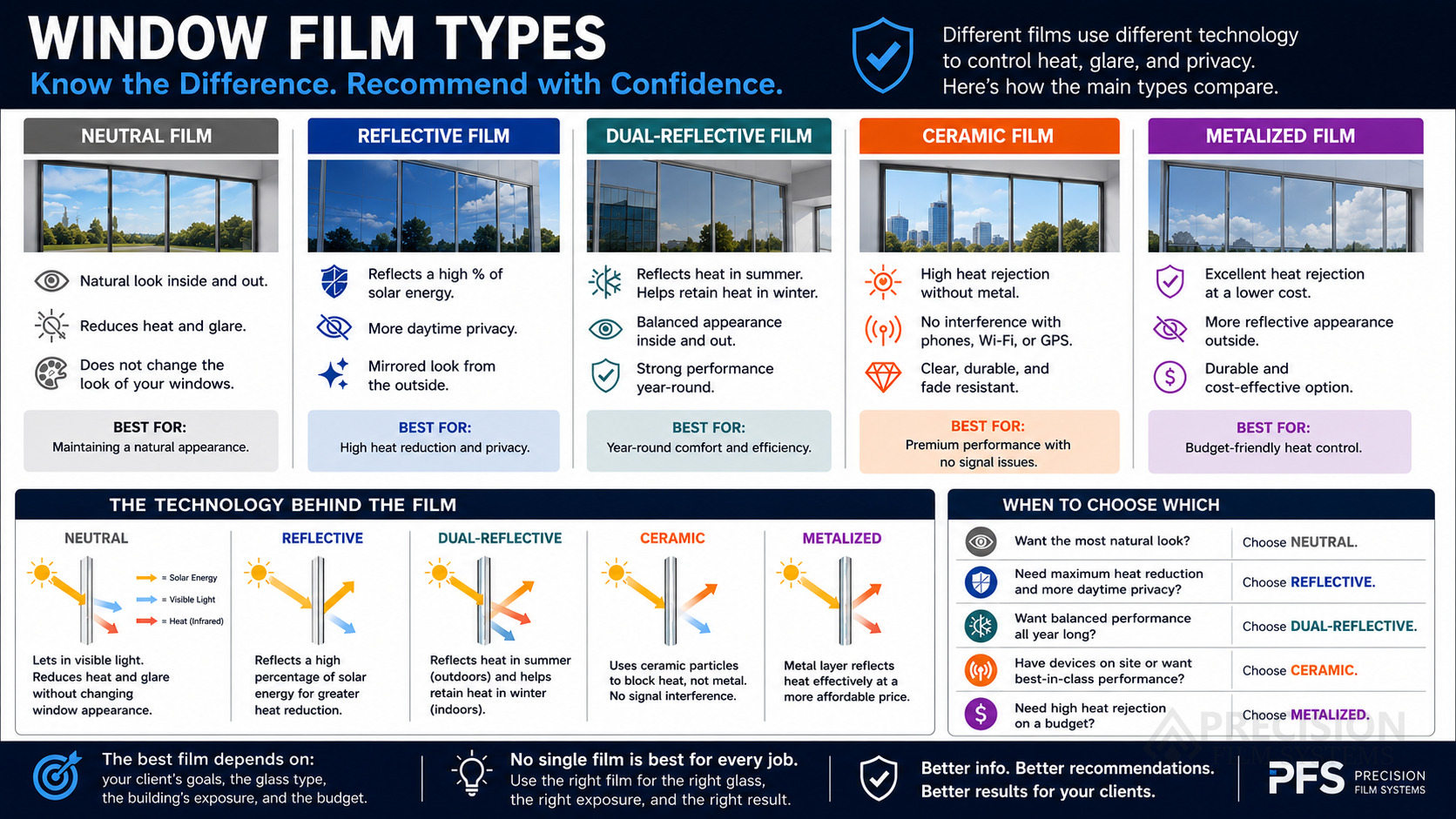
Film category names help narrow the conversation, but they do not choose the film by themselves.
Neutral, reflective, dual-reflective, ceramic, and metalized describe general appearance or construction. The recommendation still needs to be based on the customer's goal, glass type, exposure, specs, and manufacturer guidance.
Neutral Film
Neutral film usually has a more natural look.
It is often used when the customer wants solar performance without a strong mirrored appearance.
It can fit homes, offices, storefronts, HOA-sensitive jobs, and buildings where exterior appearance matters.
Neutral does not mean weak. It also does not mean approved for every glass system. Check the actual specs.
Reflective Film
Reflective film has more mirror effect.
It can help with daytime privacy when the outside is brighter than the inside. It can also provide strong solar performance depending on the product.
Reflective film needs clear expectation-setting. The exterior appearance may change. Daytime privacy depends on lighting. Nighttime privacy is different. Exterior reflectance may affect nearby glass, plants, pools, siding, traffic areas, or neighboring properties.
Compatibility still needs to be checked.
Dual-Reflective Film
Dual-reflective film has different reflectance characteristics on each side.
It is often used when the customer wants exterior reflectance or daytime privacy while keeping the interior view from feeling too mirrored.
Lighting still controls privacy. Glass type and film specs still control the recommendation.
Dual-reflective does not mean perfect privacy or perfect view.
Ceramic Film
Ceramic film uses ceramic technology rather than metalized construction.
It may be a good option when the customer wants solar performance with less reflectance. It may also come up when signal interference is a concern.
Ceramic does not automatically mean the film is best for every job. Compare VLT, TSER, SHGC, reflectance, absorption, glass type, exposure, appearance, customer budget, and manufacturer guidance.
Metalized Film
Metalized film uses metallic layers or components.
Depending on the product, it may provide strong solar performance and a more reflective appearance.
Ask whether the customer likes the look, whether reflectance is acceptable, whether signal interference is a concern, and whether the film is compatible with the glass.
Do not sell metalized film only because it sounds stronger or more technical.
What Customers Usually Care About
Customers usually ask for results, not film construction.
They want it cooler. They want less glare. They want privacy. They want a clean look. They do not want the house or building to look wrong.
Start with the result they want. Use the category name only after the goal is clear.
Customer Explanation
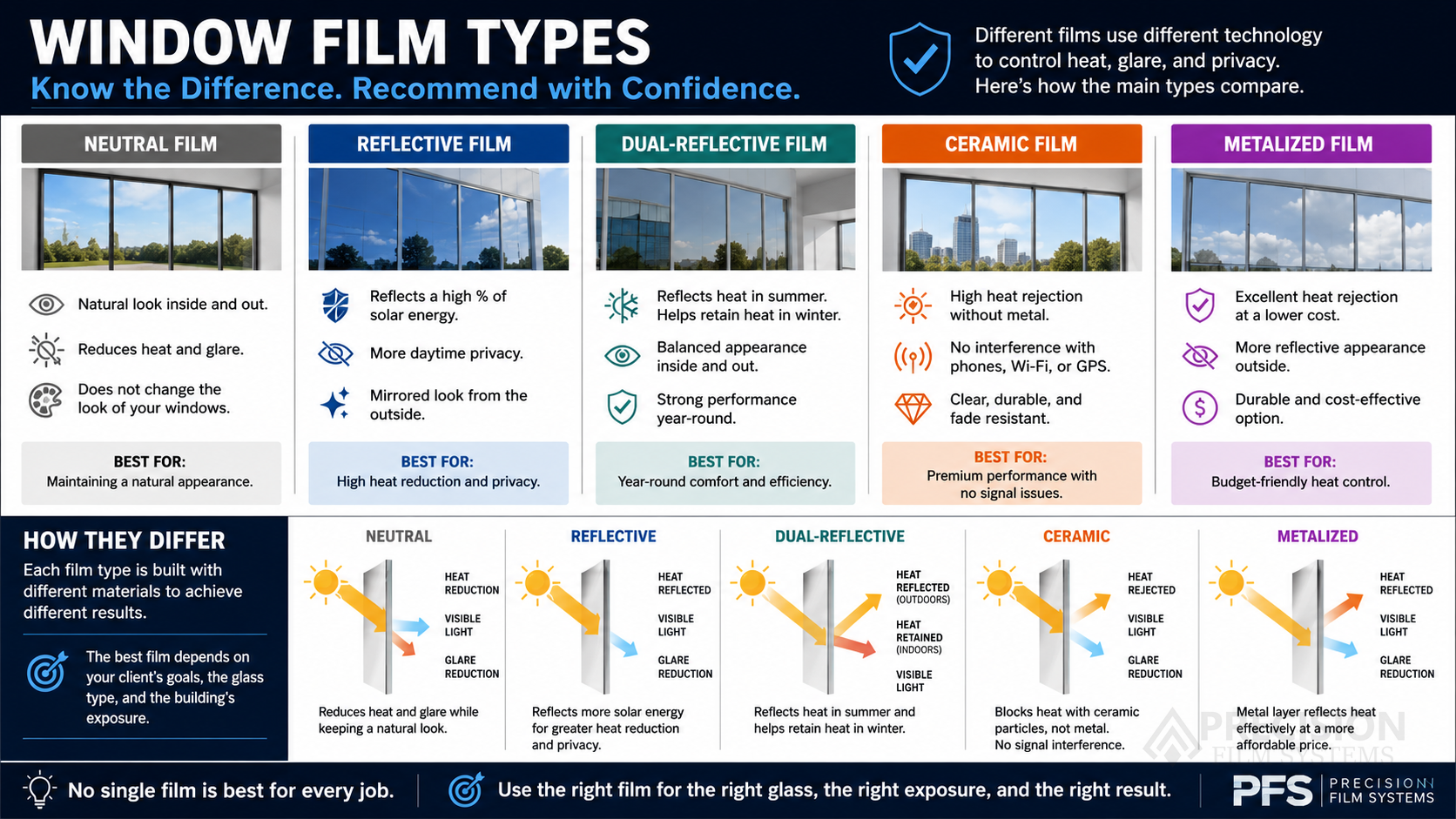
These terms describe the look or construction of the film. Neutral usually has a more natural look. Reflective has more mirror effect. Dual-reflective balances exterior reflectance with interior view. Ceramic and metalized describe how the film is built. We still need to compare the actual specs and make sure the film fits the glass and the job.
Installer Notes
Use category names as shortcuts, not final answers.
Match the film to the customer's goal, glass type, exposure, appearance expectations, specs, and manufacturer guidance.
Related Terms
- Neutral Film
- Reflective Film
- Dual-Reflective Film
- Ceramic Film
- Metalized Film
- VLT
- Reflectance
- TSER
- SHGC
- Absorption
Sources and further reading
- 2026 Flat Glass Solar Education Guide - International Window Film Association Industry education on architectural-film construction, coatings, appearance, reflectance, and broad film categories.
- 2026 Advanced Solar Control Education Guide - International Window Film Association Advanced reference for comparing film constructions and performance values without treating category labels as complete specifications.
Window film type terms
Is ceramic film always better?
No. Ceramic film can be a good option, but it is not automatically the best choice for every job.
Is reflective film better for privacy?
Reflective film can help with daytime privacy when the outside is brighter than the inside. It is not full-time privacy.
What does dual-reflective mean?
It usually means the film has different reflectance characteristics on each side, often to balance exterior reflectance and interior view.
Does neutral film still reduce heat?
It can, depending on the product. Check the actual specs.