
Emissivity describes how readily a surface gives off heat as radiant energy.
What Emissivity Means
A high-emissivity surface gives off radiant heat more easily. A low-emissivity surface gives off radiant heat less easily.
In window and glass conversations, this usually comes up when discussing Low-E glass, winter heat loss, U-Value, and film compatibility.
Emissivity is not the same thing as darkness, glare reduction, reflectivity, or visible appearance. A piece of glass can look clear and still have a coating that changes how heat moves through the glass system.
What Low-E Means
Low-E stands for low emissivity.
Low-E glass has a coating designed to affect heat transfer. The coating is usually very thin and may not be obvious by looking at the glass. Its job is to help control radiant heat movement through the window system.
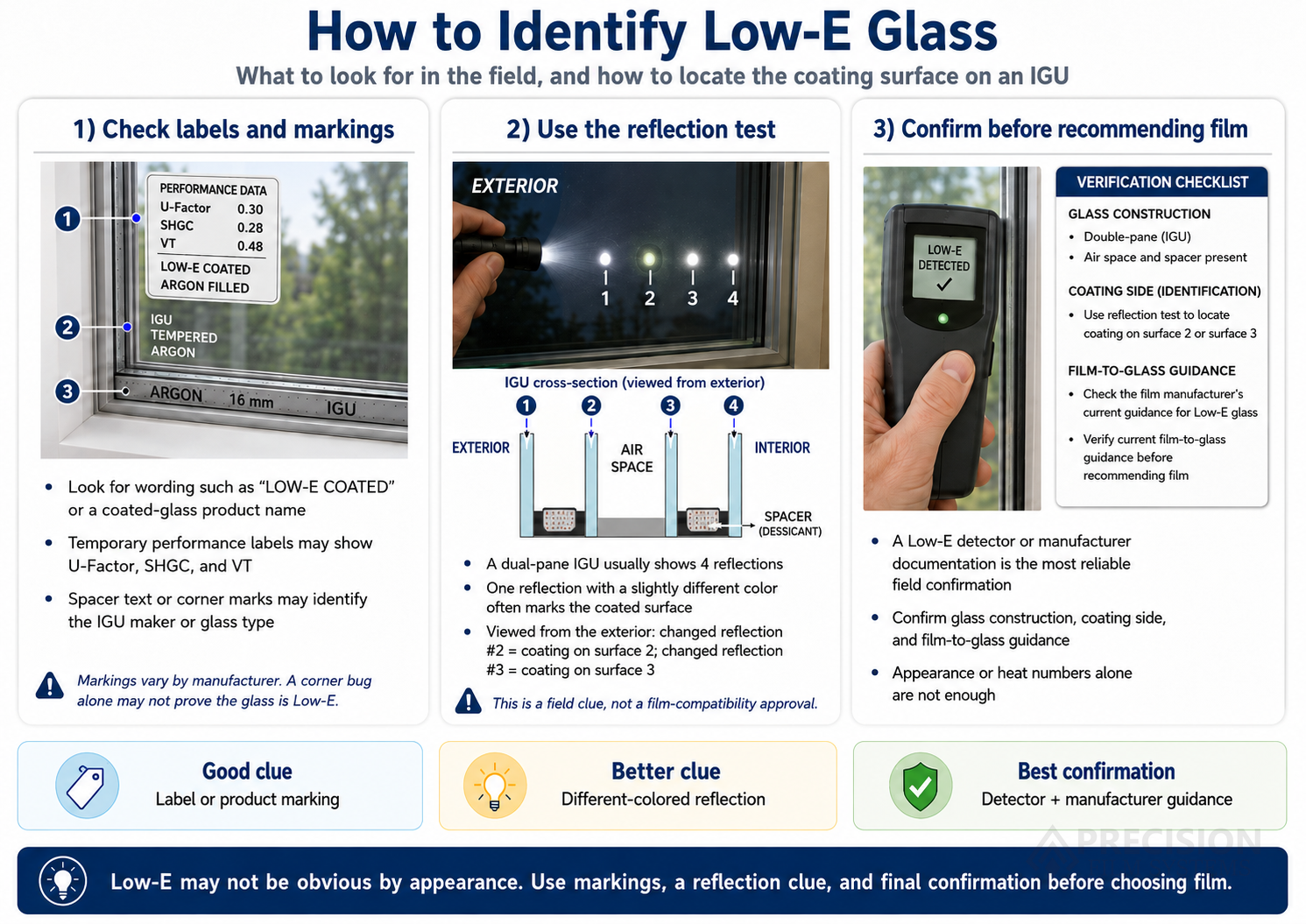
Low-E coatings are common in insulated glass units, also called IGUs. An IGU usually has two or more panes of glass with a sealed airspace between them. The Low-E coating may be on one of the surfaces facing that sealed airspace.
Low-E Is About the Glass System, Not Just the Film
A window film recommendation changes when Low-E glass is involved because the film is being added to a glass system that may already be managing heat.
Film can change how much solar energy is absorbed, reflected, and transmitted. On certain glass types or coating combinations, that added absorption can raise glass temperature and affect compatibility.
This is why Low-E questions belong in the compatibility part of the job, not just the appearance or performance part of the conversation.
A film should not be selected from appearance, darkness, TSER, IR rejection, or glare reduction numbers alone when Low-E glass is involved.
Low-E Coatings and Glass Surfaces
Installers may hear Low-E coatings described by surface location.
On a dual-pane IGU, the glass surfaces are often numbered from outside to inside:
| Surface | Plain-English location |
|---|---|
| Surface 1 | Exterior-facing outside surface |
| Surface 2 | Inside surface of the exterior pane, facing the airspace |
| Surface 3 | Inside surface of the interior pane, facing the airspace |
| Surface 4 | Room-facing inside surface |
Low-E coatings are often placed on surface 2 or surface 3, depending on the glass package and performance goal.
The exact coating location can affect which films are approved or not approved by the film manufacturer.
Why Low-E Glass Changes the Film Conversation
Low-E glass can already be controlling part of the heat-transfer behavior of the window.
Adding film may increase solar absorption in the glass or change how heat moves through the system. That does not mean film cannot be used on Low-E glass. It means the glass package, coating location, film type, shading conditions, pane size, frame type, and manufacturer guidance need to be checked before making the recommendation.
Low-E glass is not one single glass type. Different coatings and IGU constructions can behave differently.
What Emissivity Does Not Tell You by Itself
Emissivity does not tell you:
- How dark the film will look
- How much glare the film will reduce
- How much total solar energy the film rejects
- Whether the film is compatible with a specific Low-E unit
- Whether the glass is safe from thermal stress
- Whether the film manufacturer approves the installation
Emissivity is one part of the window-performance conversation. It should be read alongside SHGC, U-Value, total solar absorbance, reflectance, transmission, glass type, and manufacturer film-to-glass guidance.
What to Check Before Recommending Film on Low-E Glass
Before recommending film for Low-E glass, check:
- Whether the glass is single-pane, dual-pane, or part of an IGU
- Whether the unit has a Low-E coating
- Which surface the Low-E coating is on, if known
- Whether the glass is annealed, heat-strengthened, or tempered
- Pane size and shape
- Interior or exterior shading
- Partial shade from overhangs, mullions, trees, signs, or nearby structures
- Existing damage, chips, cracks, seal failure, or edge defects
- Film manufacturer film-to-glass charts or technical guidance
When the coating location or glass construction is unknown, the recommendation should stay cautious.
How to Explain It to a Customer
A simple way to explain it:
"Low-E glass already has a coating that affects heat movement through the window. Before choosing a film, we need to make sure the film works with that glass type and coating. The best-looking or highest heat-rejection film is not automatically the right choice for every Low-E window."
For a customer focused only on darkness or heat numbers:
"Those numbers help compare films, but Low-E glass adds another layer to the decision. We need to check compatibility so the recommendation fits the glass, not just the room."
Installer Takeaway
Emissivity explains how a surface gives off radiant heat. Low-E glass uses a coating to reduce or control that heat transfer.
For flat glass film work, Low-E should trigger a compatibility check. Film choice should be based on the full glass system, not only the film's appearance or performance numbers.
Related Terms
- Low-E Compatibility
- Compatibility Awareness Guide
- Spec Glossary Hub
- SHGC
- U-Value / Winter U-Value
- Total Solar Absorbance
- Total Solar Reflectance
- Total Solar Transmission
- IGU
- Thermal Stress
Sources and further reading
- 2026 Flat Glass Solar Education Guide - International Window Film Association Introduces emissivity, heat transfer, glass types, coatings, and Low-E glazing in architectural-film conversations.
- 2026 Advanced Solar Control Education Guide - International Window Film Association Advanced reference on glazing systems, heat transfer, solar-control measurements, and coated glass.
- Window Film Ratings and Certification - National Fenestration Rating Council Independent overview of certified window-film energy ratings and labels.
Emissivity and Low-E glass
What does emissivity mean in glass conversations?
Emissivity describes how readily a surface gives off heat as radiant energy. In window and glass conversations, it often comes up when discussing Low-E glass, U-Value, winter heat loss, and film compatibility.
What does Low-E mean?
Low-E stands for low emissivity. Low-E glass has a thin coating designed to help control radiant heat movement through the window system.
Why does Low-E glass matter for window film recommendations?
Low-E glass may already be managing heat in the glass system. Adding film can change absorption, reflection, transmission, and glass temperature, so the glass package, coating location, film type, shading, and manufacturer guidance should be checked before making a recommendation.
Where is the Low-E coating on a dual-pane IGU?
On a dual-pane insulated glass unit, Low-E coatings are often placed on surface 2 or surface 3, depending on the glass package and performance goal.
Can window film be installed on Low-E glass?
Sometimes, but it should not be assumed from appearance or film performance numbers alone. The full glass system and current film manufacturer film-to-glass guidance should be checked first.