
IR rejection shows up on a lot of window film spec sheets and sales material. The problem is that it often gets repeated as if it means total heat rejection.
A film may advertise 95% IR rejection, but that does not mean the film blocks 95% of all heat coming through the window. IR is one part of the sun's energy, not the whole performance story.
What IR Means
IR stands for infrared.
Infrared is part of the sun's energy. You cannot see it, but you can feel its connection to radiant heat when sunlight hits glass, flooring, furniture, or your skin.
In window film conversations, IR usually comes up when the customer wants the room to feel cooler without making the glass too dark.
What IR Rejection Tells You
IR rejection describes how much infrared energy the film rejects within the range being measured.
That range is not always the same from one product line or manufacturer to another. One spec sheet may be talking about a narrower part of the infrared range, while another may be using a wider range.
Two films can both advertise a high IR rejection number and still not be equal comparisons.
A cleaner way to read the number is:
IR rejection tells you how the film handles the infrared portion being measured. It does not describe the full solar performance of the film by itself.
IR Rejection Is Not Total Heat Rejection
Solar heat gain through glass is not caused by infrared alone.
The sun's energy is usually discussed in three main parts:
- UV
- Visible light
- Infrared
Visible light can enter a room and get absorbed by floors, walls, furniture, counters, and other surfaces. Those surfaces warm up and release heat into the space.
UV is a smaller part of the total solar energy, but it still belongs in the broader solar spectrum conversation.
Infrared is a large part of the heat-comfort discussion, but it is still only one part of the total energy reaching the glass.
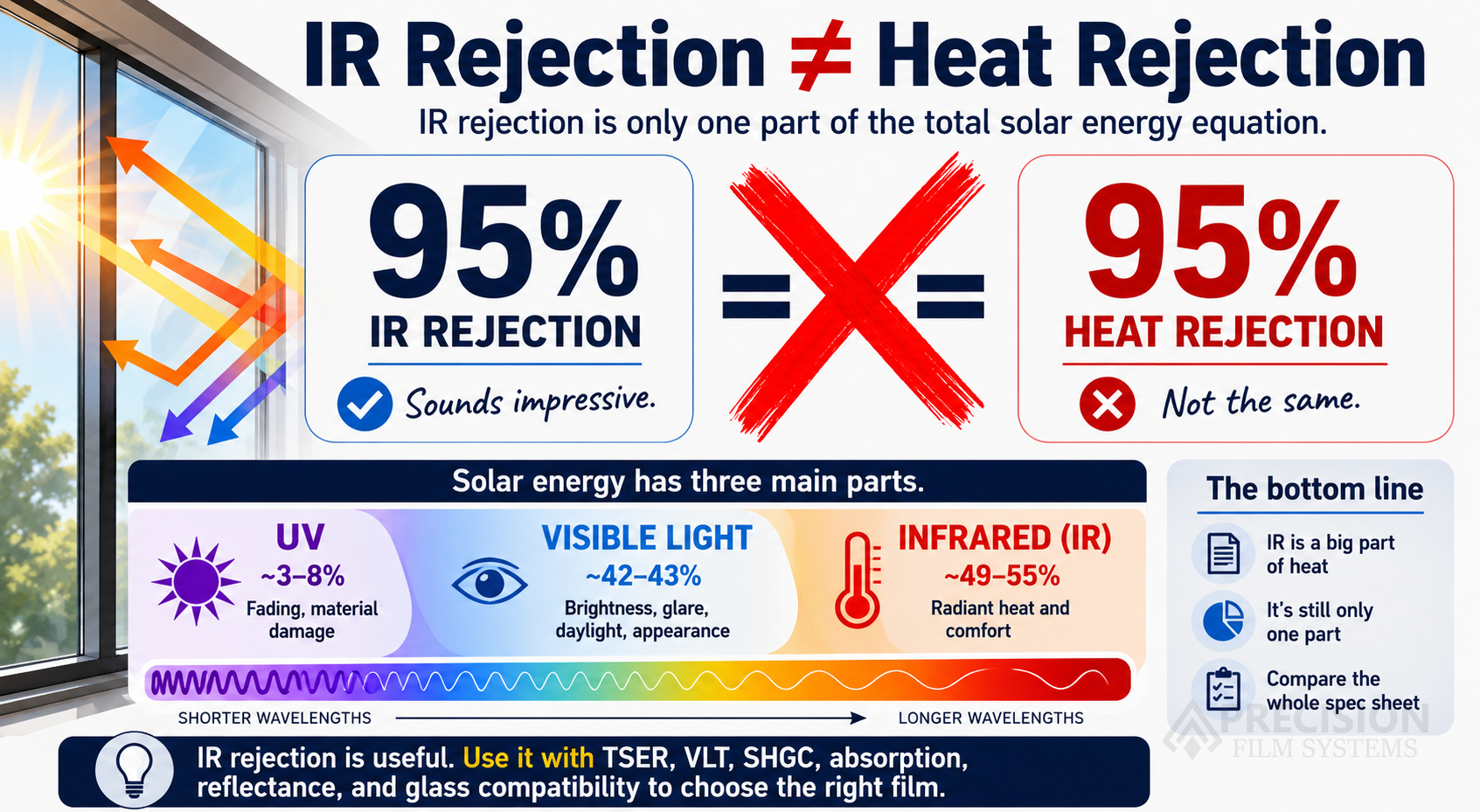
This is why 95% IR rejection should not be repeated as 95% heat rejection.
How IR Fits Into the Solar Energy Picture
A simplified solar-spectrum breakdown can help keep the IR number in context. The exact split depends on the source, wavelength range, atmosphere, glass, film, and test method, but the practical point is the same: IR is not the whole total.
| Part of solar energy | Approximate share | What it affects in the job conversation |
|---|---|---|
| UV | About 3-8% | Fading, UV protection, material damage |
| Visible light | About 42-43% | Brightness, glare, daylight, view, and appearance |
| Infrared | About 49-55% | Radiant heat and comfort near the glass |
That is why a large IR number can be useful without being the whole answer. IR is a big part of the comfort conversation, but visible light, TSER, SHGC, absorption, reflectance, glass type, and exposure still matter.
Why Lighter Films Can Still Perform Well
A lighter film can sometimes reject a lot of infrared while allowing more visible light through.
That is common with films designed to keep the room brighter while still reducing a meaningful amount of solar discomfort.
So a customer may see a lighter film and assume it will not perform well. The spec sheet may tell a different story.
The reverse can also happen. A darker film may cut more visible light and glare, but that does not automatically make it the best heat-control option for every flat glass job.
What to Check Besides IR Rejection
IR rejection is useful, but it should be read with the rest of the spec sheet.
| Spec or job detail | Why it matters |
|---|---|
| TSER | Shows total solar energy rejected under the tested condition. |
| SHGC | Helps describe how much solar heat gain still enters through the window system. |
| VLT | Sets expectations for daylight, appearance, and visible glare. |
| Solar absorption | Can affect glass temperature and compatibility questions. |
| Reflectance | Affects appearance, privacy expectations, and how energy is handled. |
| Glass type and coating information | Single pane, insulated glass, Low-E coatings, and existing conditions can change the recommendation. |
| Shading and exposure | Partial shade, orientation, and sun load can matter more than a single spec number. |
| Manufacturer guidance | Film-to-glass charts and product guidance should carry the compatibility decision. |
The IR number can help explain part of the performance. It should not carry the whole recommendation.
IR Rejection and Glass Risk
IR rejection by itself is not usually the glass-risk number.
Glass risk questions usually come back to the full glass and film system. Solar absorption, glass type, coatings, IGUs, partial shading, edge condition, and manufacturer guidance all carry more weight in that conversation.
A high IR rejection film may still need review if the glass has Low-E coatings, heavy shade patterns, existing damage, or other compatibility concerns.
Do not use the IR number as a shortcut around the film-to-glass check.
How to Explain IR Rejection to a Customer
A simple explanation is:
"IR rejection tells us how much infrared energy the film rejects in the tested range. Infrared is connected to radiant heat, but it is not the only part of the sun's energy. We still need to compare TSER, visible light, absorption, reflectance, and the glass type before choosing the film."
That keeps the claim closer to the spec sheet.
Installer Takeaway
IR rejection is a useful number, especially when the customer wants heat control without a very dark film.
Do not answer "which film blocks the most heat?" with the IR number alone.
Use IR rejection as one part of the comparison. Then check it against TSER, SHGC, VLT, absorption, reflectance, and glass compatibility.
The better recommendation is not the film with the biggest IR number. It is the film that fits the glass, the exposure, the appearance goal, and the customer's actual problem.
Related Terms
- TSER
- SHGC
- VLT
- UV Rejection
- Solar Absorption
- Reflectance
- Film-to-Glass Compatibility
Sources and further reading
- 2026 Flat Glass Solar Education Guide - International Window Film Association Explains the solar spectrum, infrared energy, transmitted and absorbed energy, and commonly reported film-performance terms.
- 2026 Advanced Solar Control Education Guide - International Window Film Association Advanced reference on wavelength ranges, solar-control measurements, and comparing partial-spectrum claims with whole-system performance.
IR rejection and heat rejection
Is IR rejection the same as heat rejection?
No. IR rejection describes how much infrared energy is rejected within the measured range. Total heat performance should also consider TSER, SHGC, VLT, absorption, reflectance, glass type, and job conditions.
Does 95% IR rejection mean 95% heat rejection?
No. A 95% IR rejection claim does not mean the film blocks 95% of all solar heat. Infrared is only one part of the sun's energy, and the measured IR range can vary by manufacturer or product line.
Why can a lighter window film still have strong IR rejection?
Some films are designed to reject a meaningful amount of infrared energy while allowing more visible light through. That can help keep a room brighter while still improving solar comfort.
What should I compare with IR rejection?
Compare IR rejection with TSER, SHGC, VLT, solar absorption, reflectance, glass type, Low-E coating information, single pane or insulated glass construction, exposure, shading, and manufacturer film-to-glass guidance.
Is IR rejection the glass-risk number?
Usually no. Glass risk questions depend more on the full film and glass system, including solar absorption, glass type, coatings, IGUs, partial shading, edge condition, existing damage, and manufacturer guidance.