
Square footage is where most flat glass quotes start, but it is not where the material decision ends.
Once the job has to be ordered, pulled, or cut, the shop needs to know how the measured panes actually lay out on the roll.
That is where linear feet becomes more than just another number on the material side.
In Practical Terms
Linear feet matters because it shows how much roll length the job may use after the pane sizes, quantities, roll width, and orientation are considered. Two jobs can have the same measured glass square footage and still use very different roll footage. That difference can affect the order length, waste, leftover film, and whether the quote is carrying the material correctly.
Square Footage Does Not Show the Roll Layout
Square footage is useful. It gives the shop a measured glass area, helps with pricing, and gives the job a clean scope number.
But square footage does not show how the pieces land on the roll.
That is the part that can make a job look better on paper than it does in the material plan. The glass area may be right, the quote may look fine, and the film may already be selected. But the shop still has to answer the roll question.
How much length is this job actually going to use?
That answer depends on pane sizes, quantities, roll width, orientation, and layout. It does not come from square footage alone.
Same Square Footage, Different Linear Feet
Take two simple jobs.
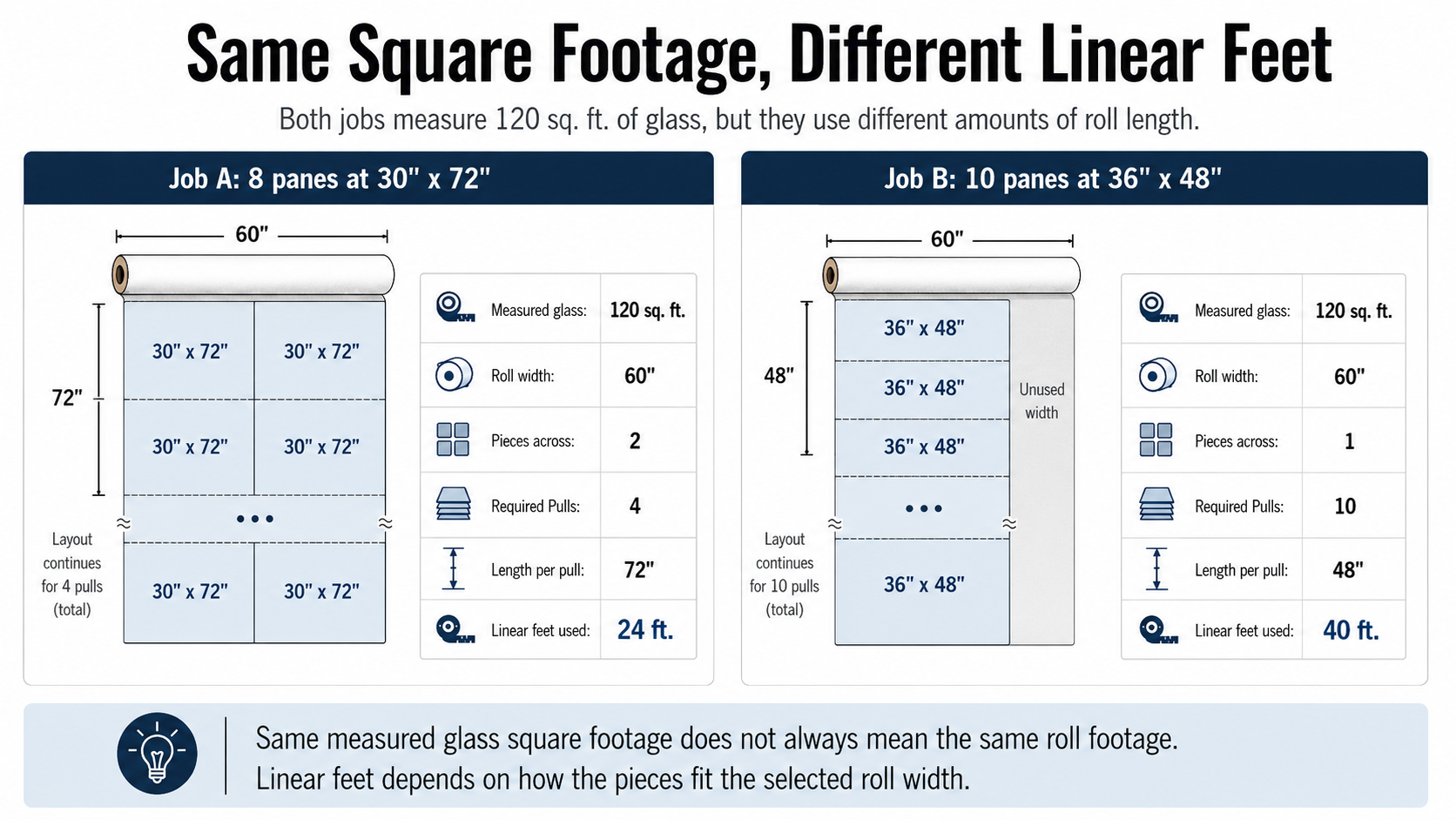
Both have 120 square feet of measured glass.
| Job | Pane sizes | Quantity | Measured glass area |
|---|---|---|---|
| Job A | 30" x 72" | 8 | 120 sq. ft. |
| Job B | 36" x 48" | 10 | 120 sq. ft. |
From a square-footage view, those jobs look the same.
From a roll-layout view, they are not.
For this example, assume both jobs are being checked on a 60" roll and the pieces are kept in the same orientation. The point is not to decide the final cut plan yet. The point is to show why the square-foot number does not carry the whole material decision.
Job A on a 60" Roll
Job A has eight panes at 30" x 72".
On a 60" roll, two 30" pieces fit across the width.
| Job A layout | Number |
|---|---|
| Pieces across the roll | 2 |
| Require Pulls | 4 |
| Length per row | 72" |
| Total used length | 288" |
| Linear feet used | 24 ft. |
Job A uses 24 linear feet from the 60" roll before any extra allowance, handling, trim, or ordering increment is considered.
The measured glass area is 120 square feet, and the layout uses the roll width cleanly.
Job B on a 60" Roll
Job B has ten panes at 36" x 48".
On the same 60" roll, only one 36" piece fits across cleanly when the 36" side is running across the roll. That leaves unused width beside each piece and pushes the job into more rows.
| Job B layout | Number |
|---|---|
| Pieces across the roll | 1 |
| Require Pulls | 10 |
| Length per row | 48" |
| Total used length | 480" |
| Linear feet used | 40 ft. |
Job B also has 120 square feet of measured glass.
But it uses 40 linear feet from the same roll width.
That is the material-planning issue. The square footage did not change, but the roll footage did.
The Roll Width Can Change the Answer Again
Now take Job B and check it against a 72" roll.
Two 36" pieces fit across the width.
| Job B layout | Number |
|---|---|
| Roll width | 72" |
| Pieces across the roll | 2 |
| Require Pulls | 5 |
| Length per row | 48" |
| Total used length | 240" |
| Linear feet used | 20 ft. |
Same panes. Same quantity. Same measured glass.
Different roll width.
Different linear feet.
That does not automatically make the 72" roll the better purchase. It only means the layout uses less roll length. The shop still has to look at cost, order increment, leftover material, availability, and whether that roll width makes sense for the job.
That is where linear feet belongs in the decision. It is not the final answer by itself. It is one piece of the material plan.
Lower Linear Feet Is Not Always the Better Buy
The lowest linear-foot layout can look like the cleanest answer, but it still needs context.
Thirty feet of 72" film is not the same purchase as 30 feet of 48" film. A wider roll may use less length and still cost more to buy. A layout may use fewer linear feet and still require the same order length. It may also leave a larger remainder that is only useful if the shop can actually use it later.
That is why the material decision should not stop at the lowest linear-foot number.
A better review looks at:
| Material question | Why it matters |
|---|---|
| What roll width is being compared? | Linear feet across different roll widths is not the same purchase |
| What order length is required? | Used length and purchased length are not always the same |
| How much cut-layout waste is created? | Waste can affect cost and margin |
| Is the remainder useful? | Leftover film only helps if it can be tracked and reused |
| Can the pieces be rotated? | Orientation can change the layout and the linear footage |
| Is the cut plan practical? | A layout can fit mathematically and still be awkward to work from |
The point is not to chase the smallest number.
The point is to know what the number is actually telling the shop.
Linear Feet Used Is Different From Order Length
A layout may use 31 linear feet. That does not mean the shop gets to buy exactly 31 feet.
The film may be sold in set increments. The supplier may have minimums. The shop may decide to order extra because of trim, handling, difficult access, or future use. The job may also be pulled from film already on hand.
Those are separate questions.
| Number | What it tells the shop |
|---|---|
| Linear feet used | How much roll length the layout may consume |
| Order length | How much film needs to be bought, pulled, or allocated |
| Remainder | What may be left after the job is cut |
This is where a job can get misunderstood. The layout might use 31 feet, but the order may still be 50 feet. The remaining 19 feet is not automatically waste, but it is not automatically useful either.
It only becomes useful if the shop can identify it, protect it, and plan around it later.
Waste and Remainder Should Not Be Blended Together
Cut-layout waste and leftover film are related, but they are not the same thing.
Cut-layout waste is material lost because of how the pieces fit inside the layout. Remainder is material left on the ordered or pulled roll after the job is planned or cut.
A job can have a clean layout and still leave a lot of film behind because of order increments. Another job can have more layout waste but leave less remaining material on the roll.
Those details matter when the shop is deciding what to buy, what to keep, and what to count on later.
If leftover film is not tracked, it usually turns into a vague memory. Someone remembers there might be a partial roll somewhere, but nobody is sure how much is left, what width it is, what film it is, or whether it is still worth using.
That is not a reliable material plan.
Orientation Can Change the Layout
Orientation is part of the linear-foot conversation because turning pieces can change how many rows the job needs.
Sometimes rotation makes the layout cleaner. Sometimes it reduces length. Sometimes it lets a wider roll make sense. Sometimes it creates a layout that looks good on paper but does not match how the shop wants the film handled.
That is why orientation should be reviewed with the job in mind.
Factory roll direction, appearance, film type, installer preference, and manufacturer guidance may all matter depending on the product and the job. The layout needs to be useful, not just technically possible.
Linear feet should come from a layout the shop is willing to stand behind.
Where Linear Feet Fits in the Flat Glass Workflow
Linear feet becomes useful after the measurements are organized and before the shop commits too far to the quote, order, or cut plan.
That is the middle part of the job.
The shop has the pane sizes. It has the quantities. It may already have the film selected. Now the job needs to be checked against the roll.
A practical material review should answer:
| Question | Why it matters |
|---|---|
| How much roll length does this job use? | Shows the layout-based material need |
| Which roll width makes sense? | Helps compare cost, waste, and order length |
| Is the quote carrying enough material? | Keeps square footage from hiding a weak material number |
| What needs to be ordered or pulled? | Connects the job plan to the purchase decision |
| What leftover film will remain? | Helps separate waste from usable inventory |
| Is the layout practical? | Keeps the cut plan connected to the real job |
The customer does not need every internal planning number. The shop does.
That is the difference between a quote that only has measured glass area and a quote backed by a real material plan.
Common Ways Linear Feet Gets Misread
One mistake is using square footage as if it already answered the roll question. It does not. Square footage tells the shop the measured glass area. It does not show roll width, orientation, rows, order length, or waste.
Another mistake is treating the lowest linear footage as the automatic winner. Lower length can be better, but it still has to be compared against roll width cost, order length, and leftover material.
A third mistake is blending leftover film into waste without thinking about whether the remainder can realistically be used. Some leftover film is waste. Some is inventory. The difference depends on whether the shop can track it and plan with it.
The larger mistake is waiting too long to check the material side. If linear feet is only reviewed after the quote is accepted or after film is ordered, the shop has less room to make a clean decision.
How Precision Film Systems Fits Into This
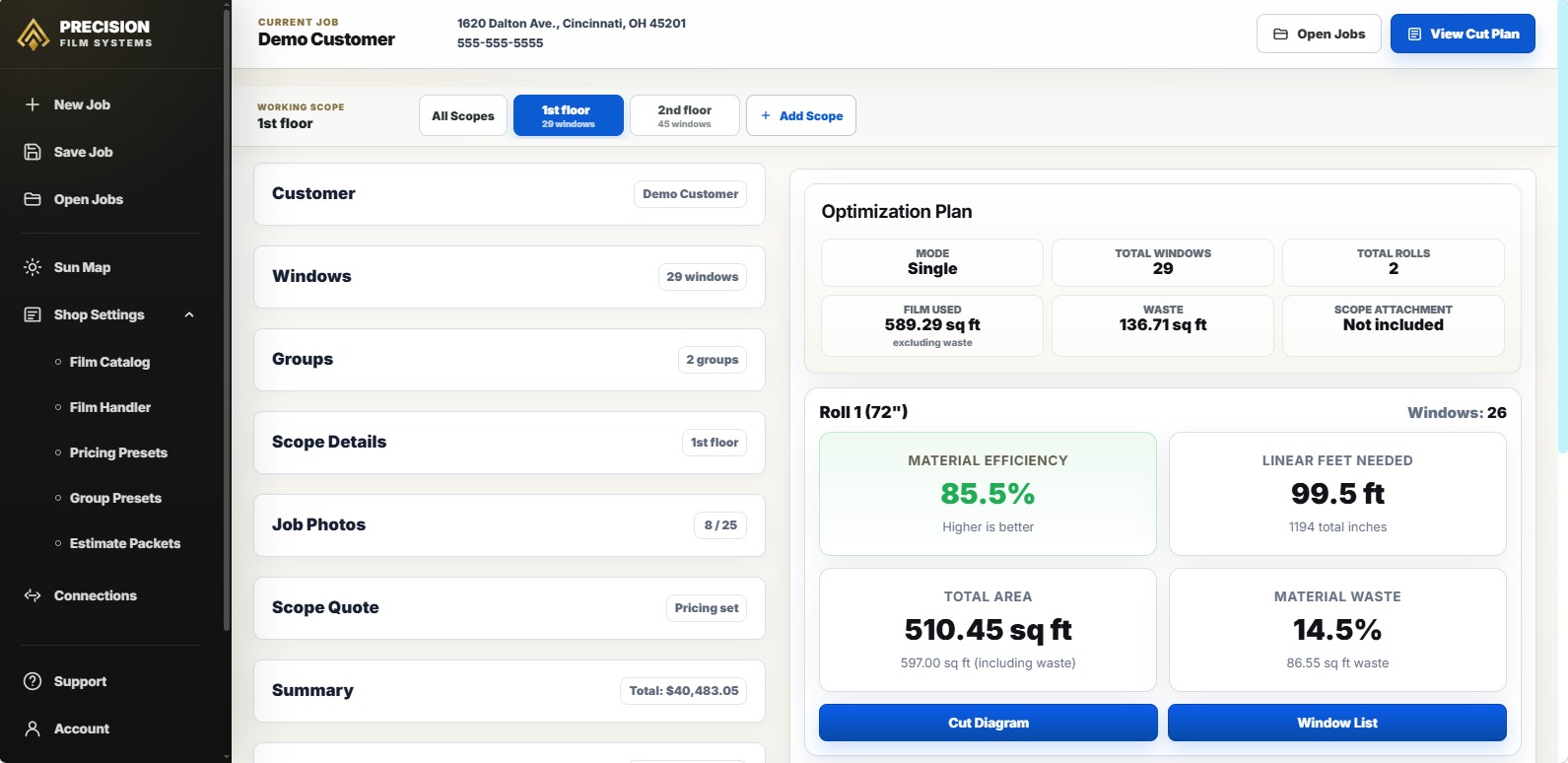
Precision Film Systems is built for the part of the job where measurements need to become usable material numbers.
It does not replace measuring. It does not choose film for the installer. It does not replace judgment.
It helps organize pane sizes, quantities, film information, roll-width comparisons, linear feet, waste, and cut-layout planning so the shop can see what the material side is doing before the job gets too far along.
Square footage alone can make the job look finished before the roll decision has really been worked through.
With Precision Film Systems, the shop can compare roll widths, review linear feet, look at waste, and see whether one option is actually cleaner or just looks cleaner at first glance.
If leftover material is part of the decision, Film on Hand mode can also help bring that material into the planning process instead of leaving it as a guess from the shelf.
The goal is not to make the job more complicated.
The goal is to make the material decision visible.
Linear feet after square footage is measured
Is square footage enough to order window film?
Not by itself. Square footage tells the shop the measured glass area. Ordering still depends on roll width, pane sizes, orientation, linear feet, order length, cut-layout waste, and leftover material.
Why can two flat glass jobs with the same square footage use different linear feet?
Because the individual panes may fit the roll differently. One job may use the roll width cleanly, while another may require more rows, more roll length, or leave unused width beside each piece.
Does lower linear feet always mean the better roll choice?
No. Lower linear feet can help, but the shop still has to compare roll width cost, order length, leftover film, availability, and whether the cut plan is practical.
Is leftover film the same as waste?
Not always. Waste is material that cannot realistically be used. Remainder left on a roll may still be usable inventory if it is protected, labeled, tracked, and considered on a future job.
How does Precision Film Systems help with linear feet?
Precision Film Systems helps turn entered window measurements into roll-width comparisons, linear feet, waste, and cut-layout planning information so the shop can review the material side before ordering, cutting, or quoting too far ahead.