
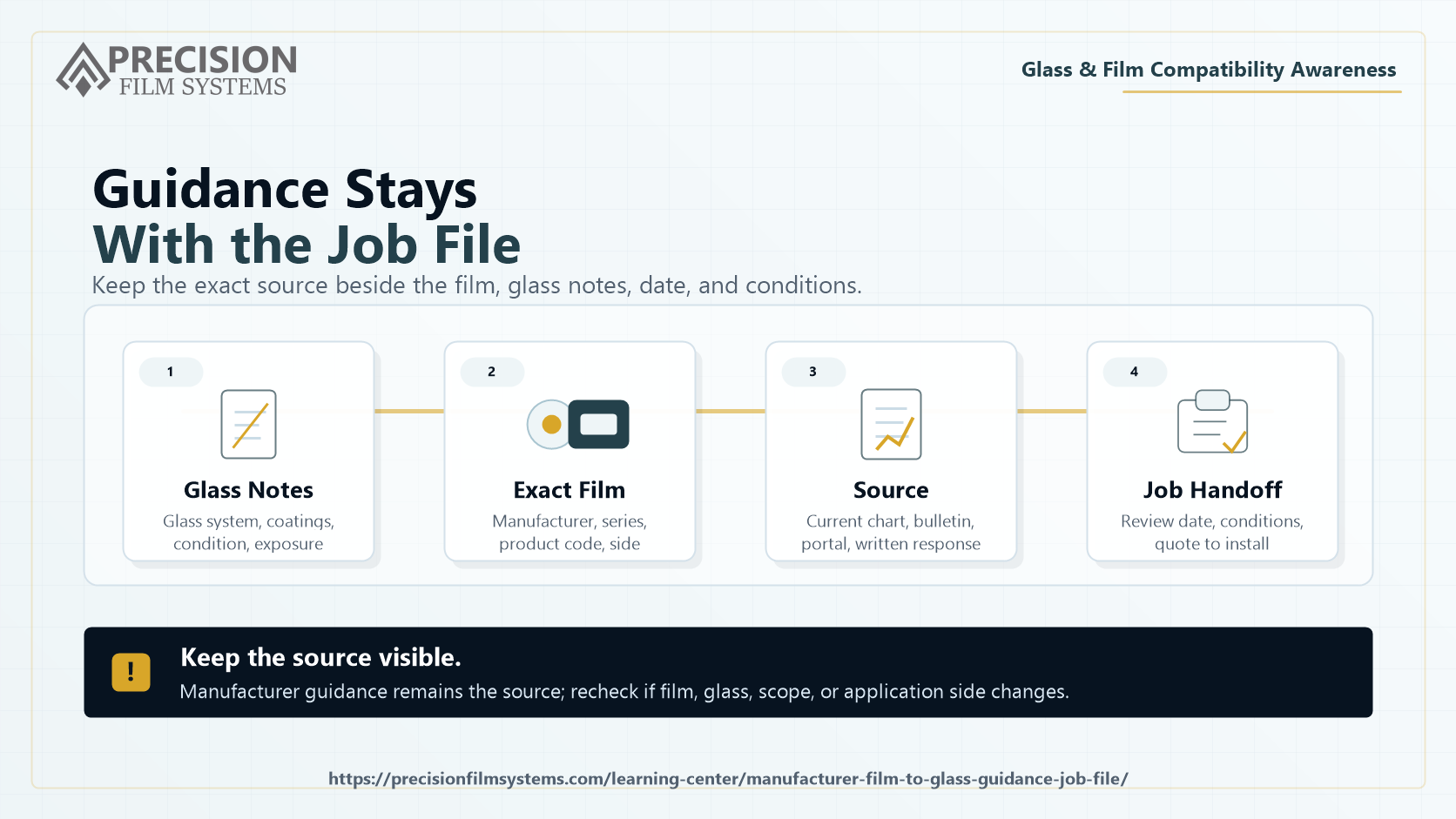
A film recommendation can look settled when the quote is written and still become weak later.
The estimator may have checked a film-to-glass chart. The office may order from a different product family because one width is unavailable. The installer may get the job weeks later with only a product name and a pane list. If the compatibility source is not kept with the job, the reason behind the recommendation can disappear.
Manufacturer guidance should not live in somebody's memory, camera roll, or old screenshot folder. It should stay with the job file.
In Practical Terms
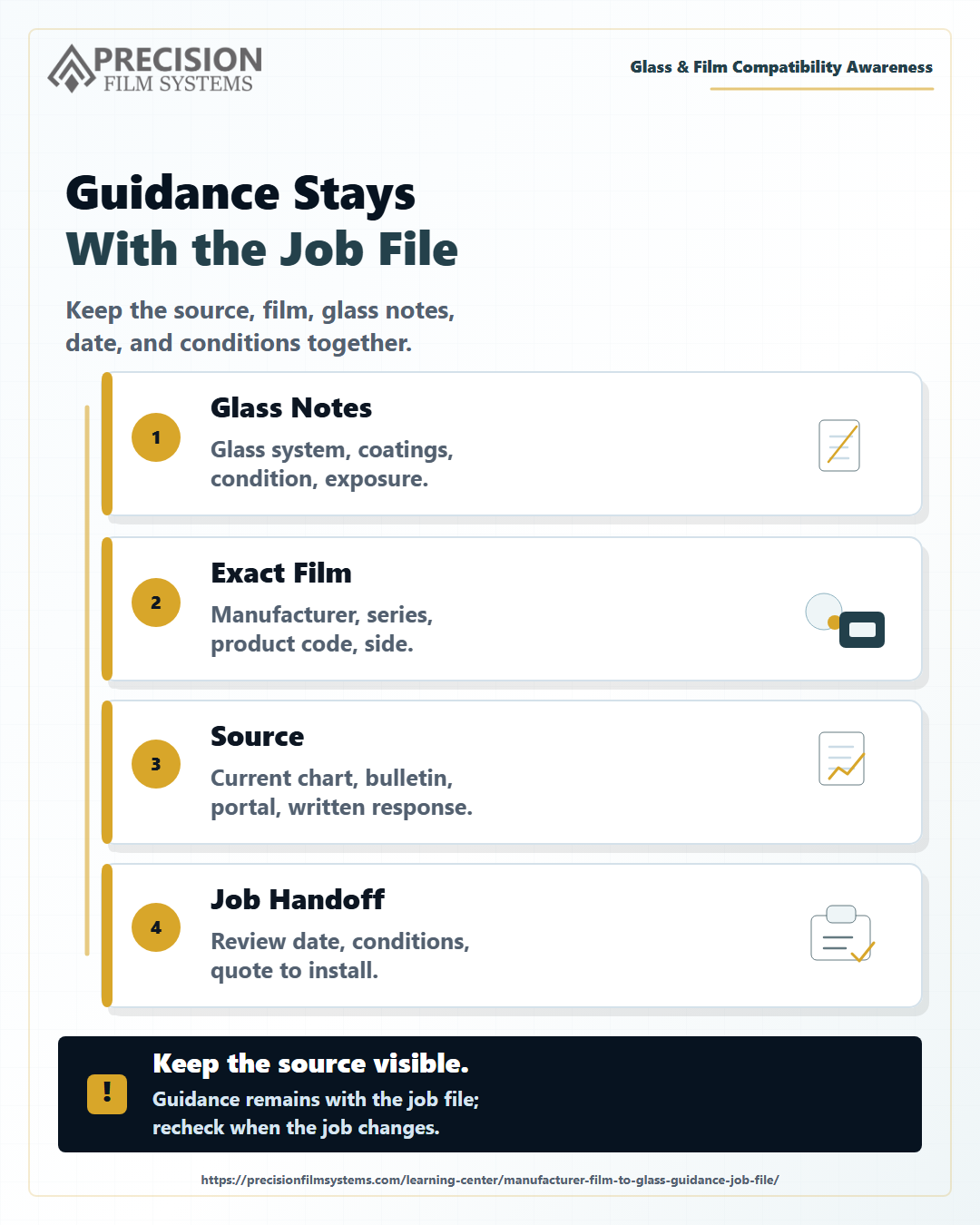
Keep the current manufacturer film-to-glass chart, technical bulletin, portal result, email, or case reference with the job file. The record should show the exact film, the glass information used, the review date, and any conditions or exceptions. A note that says "checked" is not enough if nobody can see what was checked.
The Job File Needs More Than a Product Name
A product name by itself does not explain why the film was recommended.
Two films can look similar and have different absorption, reflectance, warranty language, glass limits, or application requirements. The same film can also be treated differently when the glass changes from single-pane clear glass to an insulated glass unit, tinted glass, laminated glass, Low-E glass, or glass with unknown construction.
That is why the compatibility record should connect three things:
| Job-file item | Why it matters |
|---|---|
| The exact film product | Similar names or categories can hide different performance values |
| The glass information used | Manufacturer guidance depends on the glass condition being reviewed |
| The manufacturer source | The shop needs to know where the recommendation came from |
Without those pieces, the next person is left to rebuild the review or trust a short note that may not be complete.
What Counts as Manufacturer Guidance
The best source is the current information published or supplied by the film manufacturer for the exact product being considered.
Depending on the brand and product line, that may be:
- a film-to-glass chart
- an online tool or dealer portal result
- a technical data bulletin
- a warranty or application guide
- a written technical-service response
- a project-specific case number or email
Distributor advice can be useful, especially when the distributor knows the product line well. But when compatibility, glass breakage coverage, seal failure coverage, or warranty handling depends on manufacturer requirements, the job file should still show the manufacturer basis.
Do not reduce a conditional answer to one word. If the response depends on glass thickness, Low-E surface, exterior installation, edge seal, pane size, shading, or written technical response, those conditions belong in the file.
Record the Glass Information Behind the Review
A saved chart is only useful if the job file also shows what glass condition was reviewed.
At a minimum, keep the details the manufacturer guidance used or requested:
| Detail to keep | Practical note |
|---|---|
| Single-pane or insulated glass unit | IGUs often need more specific review than a simple pane note |
| Glass type when known | Annealed, heat-strengthened, tempered, laminated, tinted, or unknown |
| Low-E or coating notes | Surface location matters when it can be confirmed |
| Pane condition | Visible chips, cracks, seal failure, scratches, or old glazing concerns should be recorded |
| Exposure and shading | Direction, strong sun period, partial shade, and interior coverings can matter |
| Application side | Interior and exterior applications may be treated differently |
| Film product and series | Include manufacturer, line, product code, and shade where possible |
If something is unknown, mark it as unknown. Do not turn uncertainty into a confident label just to make the job file look complete.
That distinction matters. "Unknown Low-E surface" is much more useful than "Low-E ok" with no source, no date, and no record of how the answer was reached.
Add the Review Date and Version
Manufacturer charts, product lines, warranty terms, and technical guidance can change.
A saved PDF, screenshot, portal result, or email should include the date it was checked. If the document has a revision date, keep that too. The point is not to build a museum of paperwork. The point is to show what guidance the shop used when the recommendation was made.
This becomes important when a job is delayed, revised, or handed off. A film that was reviewed during the first quote may not be the film that gets ordered. A replacement pane may not match the original elevation. A manufacturer may update the chart before the job is installed.
The date helps the shop see whether the review still belongs to the current job.
Example: When the Short Note Is Not Enough
Say a commercial job has several insulated glass units with a Low-E coating. During the first review, the estimator checks the selected film against the manufacturer's guidance and writes:
Compatibility checked.
That note feels fine until something changes.
Two weeks later, the original film is not available in the width the shop planned. A similar-looking film from the same family is substituted. The office still sees "compatibility checked," but the job file does not show which film was checked, which chart was used, whether the Low-E surface was known, or whether the substitute product carries the same guidance.
The better file would show:
| Record | Example |
|---|---|
| Original product reviewed | Manufacturer, series, product code, shade |
| Glass condition used | IGU, Low-E surface when known, tint/coating notes, exposure notes |
| Source | Film-to-glass chart, technical bulletin, portal result, or technical-service email |
| Date reviewed | Date the source was checked |
| Conditions | Any limits, exclusions, edge-seal notes, written-response requirements, or unknowns |
| Revision note | Recheck required if product, glass, scope, or application side changes |
That does not make the job complicated. It keeps the recommendation from being separated from the information that supported it.
Recheck When the Job Changes
The original compatibility review should not be treated as permanent if the job changes.
Recheck before moving forward when:
- the selected film changes
- the product line changes
- the installation side changes
- the glass type or pane group changes
- replacement panes are discovered
- Low-E or coating information is updated
- the job expands to a different elevation
- shading or interior covering conditions are different from the original note
- the manufacturer guidance is old or cannot be found
A changed material plan can still be clean from a roll-width and cut-layout standpoint while the film-to-glass review is no longer tied to the current product. Those are separate checks.
Keep the Source Visible During Handoff
Compatibility notes should not stay only with the person who sold the job.
The office, ordering person, shop prep, and field installer may all need to see which film was selected and what the recommendation was based on. If different glass groups use different films, the source should stay connected to those groups.
This is especially important on jobs with multiple elevations, mixed glass, phased work, or a product change after the first quote.
The handoff does not need to bury the installer in technical paperwork. It needs to keep the right information close enough that the crew can catch a mismatch before the wrong material is cut or installed.
How Precision Film Systems Fits Into This
Precision Film Systems is not a film-to-glass approval tool.
The manufacturer remains the source for product-specific compatibility guidance. Precision Film Systems helps with the job-information side: keeping measurements, film selection, job notes, exposure context, material planning, and output connected so the compatibility status does not get separated from the rest of the job.
Compatibility review and material planning often move at the same time. The shop may be comparing roll widths, building a cut layout, checking film availability, and preparing a quote while the film choice still needs manufacturer review.
The material plan should not hide that status. If the selected film needs verification, that note should stay visible until the final recommendation is ready.
Practical Takeaway
The manufacturer source is part of the job record.
Keep the selected film, glass notes, exposure conditions, review date, chart or written response, and any exceptions together. Then, if the product, pane, scope, or application side changes, the shop can see whether the compatibility review still applies.
That is better than relying on memory. It is also easier to explain later, easier to hand off, and easier to update before the job gets too far along.
Manufacturer film-to-glass guidance
Is manufacturer film-to-glass guidance the same as a guarantee?
No. Manufacturer guidance helps determine whether a specific film is listed, permitted, restricted, conditional, or outside guidance for a given glass condition. Warranty coverage depends on the manufacturer's current terms, required information, and any written conditions.
Is a distributor recommendation enough?
Distributor advice can be useful, but the job file should still show the manufacturer basis when compatibility or warranty coverage depends on it. Keep the current chart, technical bulletin, portal result, or written manufacturer response with the job.
Should the compatibility check be repeated if the film changes?
Yes. A similar-looking replacement film may have different absorption, construction, application guidance, or warranty terms. Recheck when the product, glass condition, application side, or scope changes.
What if the glass type or Low-E surface is unknown?
Record it as unknown and ask what information the manufacturer needs before treating the recommendation as final. Unknown glass should not be forced into a confident category just to complete the file.
Should installers receive the manufacturer guidance?
They should receive enough information to understand the selected film, glass group, conditions, and current plan. On some jobs that may mean the full chart or technical response. On others it may mean a clear job note with the source attached in the office file.