
Extra film is where a lot of flat glass jobs still lean on a rule of thumb.
That can work on simple, familiar jobs. It can also be wrong in both directions. A clean repeated-size job may not need much more than the planned layout and order increment already provide. A mixed job with awkward panes may need more film than a percentage off the measured glass makes it look like.
The better question is not "What percentage should I add?"
The better question is: What does this job need after the layout, order length, and real job conditions are visible?
In Practical Terms
Order enough extra window film to cover the planned layout, normal trim and handling, realistic rework risk, supplier order increments, and any future replacement or inventory need that actually matters for the job. Do not base the extra only on measured square footage. Some flat glass jobs need very little extra beyond the order increment. Others need more because the layout, access, film availability, or pane mix makes the job less forgiving.
Start With the Layout, Not the Percentage
A percentage can be useful as a quick check. It should not be the first number the shop trusts.
Measured square footage tells you the glass area. It does not show how the pieces fit on the roll. It does not show the roll width, the required pulls, the unused strips, the order increment, or the remainder left after the job is cut.
Extra film is not only a safety cushion. It is part of the material plan.
Before deciding how much extra to order, the shop should know:
| Planning question | Why it matters |
|---|---|
| What pane sizes and quantities are being covered? | The roll layout comes from the individual pieces |
| Which film is being used? | Different films may have different widths, costs, and availability |
| Which roll width is being planned? | Roll width changes linear feet and waste |
| How much length does the layout use? | The order has to cover the actual roll pull |
| How much cut-layout waste is visible? | Waste may already be part of the layout result |
| What order increment applies? | Purchased length and used length may not match |
| How risky is the job to cut or install? | Some jobs deserve a larger allowance |
| Would leftover film be useful later? | Extra material may become inventory, or it may become clutter |
Once those answers are visible, the extra film decision becomes a job decision instead of a habit.
Extra Film Is Covering More Than One Thing
When someone says "order extra," they may be talking about several different material issues at once.
Those issues should be separated before the shop decides what to buy.
| Material issue | What it means |
|---|---|
| Cut-layout waste | Material lost because of how the pieces fit inside the planned layout |
| Trim and handling allowance | Extra material needed so pieces can be cut and installed realistically |
| Rework allowance | Film carried for mistakes, damaged pieces, or job conditions that may require a recut |
| Order increment | The supplier's minimum or purchase step, such as buying more length than the layout uses |
| Remainder | Film left on the ordered or pulled roll after the job is planned or cut |
| Usable inventory | Remainder that is protected, labeled, tracked, and realistic to use later |
If those all get blended into one waste number, the job becomes harder to understand.
A layout can have high cut-layout waste but very little remainder. Another job can have a clean layout but leave a lot of film on the roll because of the order increment. Another job may justify extra film because the product is hard to get quickly, even if the layout itself looks clean.
Those are different reasons to order more material.
A Percentage Can Be Useful, but It Should Not Lead the Decision
Some shops use a small percentage cushion. Some use a larger one. Some adjust the number based on experience, film type, or how much they trust the measurements.
There is nothing wrong with having a shop habit.
The problem is when the habit is doing the job of the layout.
A percentage added to measured glass area does not know whether the panes fit cleanly across the roll. It does not know whether the job has twenty matching panes or a pile of mixed sidelites and transoms. It does not know whether the film is available tomorrow or has to be ordered once and done right.
The percentage should be a sanity check after the material plan is visible. It should not be the material plan.
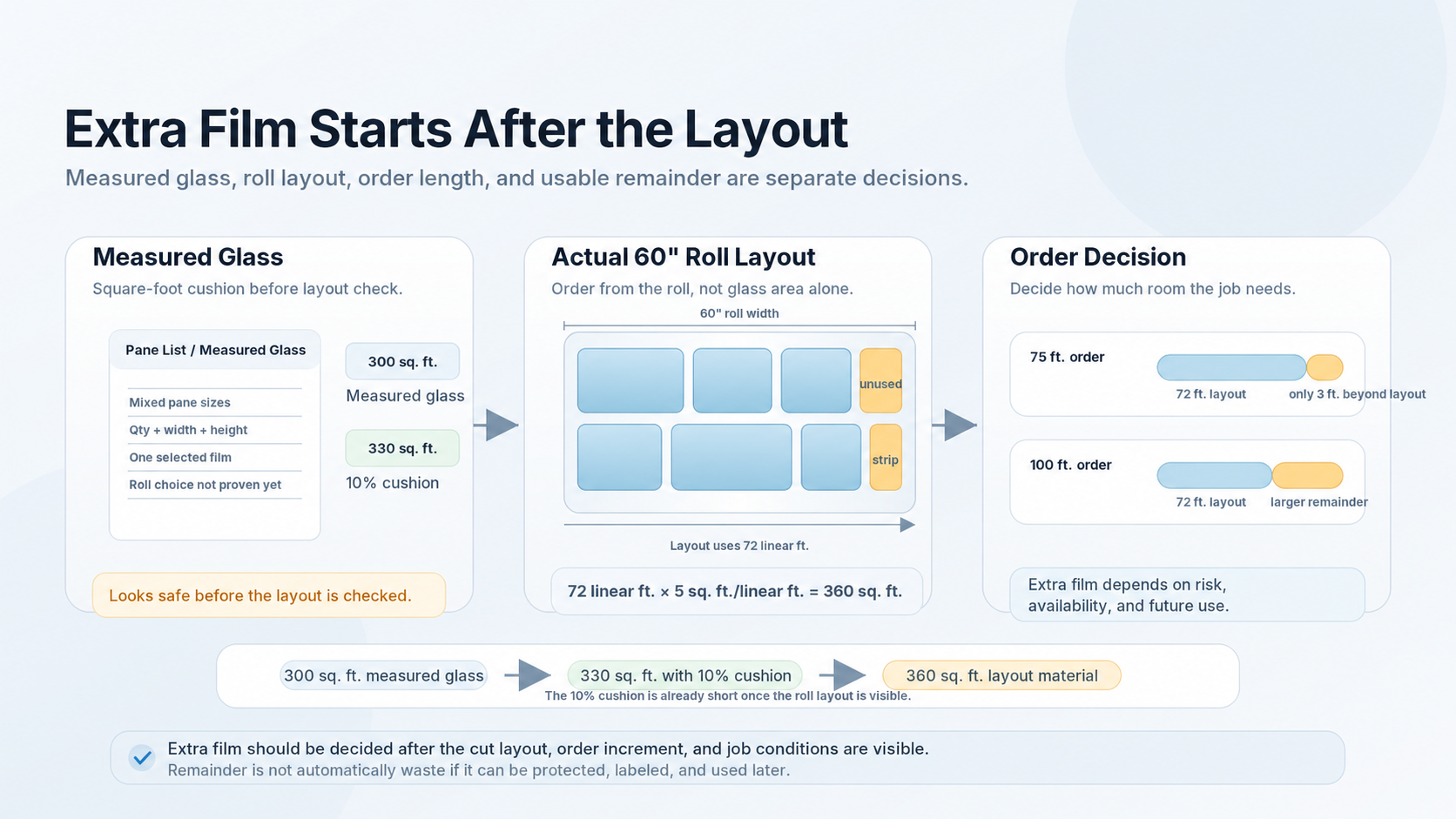
Example: When Ten Percent Is Not Enough
Take a flat glass job with:
- 300 square feet of measured glass
- one selected film
- a 60" roll
- a mixed pane list that needs 72 linear feet in the layout
A 60" roll is 5 feet wide. If the layout uses 72 linear feet, the planned roll material is about 360 square feet before any added handling allowance.
Now compare that with a simple 10% cushion on measured glass.
| Planning number | Amount | What it means |
|---|---|---|
| Measured glass | 300 sq. ft. | The glass area receiving film |
| 10% extra on measured glass | 330 sq. ft. | Looks like a reasonable cushion from the square-foot total |
| Layout on 60" roll | 72 linear ft. | The actual planned pull from the roll |
| Roll material in layout | 360 sq. ft. | What the layout consumes before extra allowance |
In this case, the 10% cushion is already short.
The issue is not that 10% is always wrong. The issue is that the percentage was attached to the glass area, while the job had to be ordered from the roll.
If the shop had ordered from the square footage cushion alone, the material side would have been weak before the first piece was cut.
Example: When the Order Increment Already Creates Extra
Now take a cleaner job:
- 12 panes
- each pane is 30" x 72"
- one selected film
- planning on a 60" roll
Two 30" pieces fit across a 60" roll. The job needs six pulls at 72" each.
| 60" roll layout | Number |
|---|---|
| Pieces across the roll | 2 |
| Required pulls | 6 |
| Length per pull | 72" |
| Total used length | 432" |
| Linear feet used | 36 ft. |
If the film is sold in 25-foot increments, this job may require a 50-foot order.
| Number | Amount |
|---|---|
| Layout length used | 36 ft. |
| Likely order length | 50 ft. |
| Remainder before handling decisions | 14 ft. |
That 14 feet is not automatically waste. It may cover normal handling, a recut, or future use. It may also be more than the job needs if the layout is clean and the shop has no reason to carry extra.
This is why blindly adding another percentage can overstate the order. The order increment may already create a cushion. The shop still has to decide whether that cushion is enough for the job conditions.
What Should Push the Extra Film Higher?
Some jobs deserve more room than others.
That does not mean the shop should pad every job the same way. It means the extra film decision should react to the job in front of you.
| Job condition | Why it may call for more film |
|---|---|
| Many small or odd panes | Repeated cuts and awkward offcuts can make the layout less forgiving |
| Mixed doors, sidelites, transoms, and large panes | The job may not pair cleanly on one roll width |
| Difficult access or tight schedule | A recut may be harder to recover from if extra film is not on hand |
| Film is hard to replace quickly | A short order can delay the job or create a second freight hit |
| Product has long lead time or limited availability | The shop may prefer a larger usable remainder |
| Large panes with little room for error | A single damaged or miscut piece can consume a meaningful amount of film |
| Multiple film types on one job | Each product needs its own allowance and order decision |
| Future replacement is likely or expected | Extra material may have value if it can be stored and identified |
The extra film is not only covering waste. It may be protecting the schedule, reducing the chance of a second order, or giving the shop a real replacement option later.
Those reasons can be valid. They just need to be visible.
What Can Keep the Extra Film Modest?
Other jobs do not need much extra beyond the planned layout and order increment.
A job with repeated sizes, a clean roll fit, easy availability, and a realistic remainder may not need a large additional cushion. Ordering too much can turn a strong material plan into a shelf full of partial rolls that nobody trusts later.
| Job condition | Why the extra may stay modest |
|---|---|
| Repeated pane sizes | The layout is easier to predict and verify |
| Clean roll-width fit | Less cut-layout waste is created |
| Film is easy to reorder quickly | A second order is less risky if something unusual happens |
| Order increment already leaves useful length | The purchase may already provide enough cushion |
| Extra remainder has no likely future use | More material may just become stale inventory |
| The shop already has usable Film on Hand | Existing inventory may cover a small shortage or replacement need |
The point is not to order as little as possible.
The point is to order from the material plan instead of from fear or habit.
Extra Film, Remainder, and Waste Are Not the Same Thing
This is where a lot of material conversations get muddy.
Waste is material that cannot realistically be used. Remainder is film left on the ordered or pulled roll. Extra allowance is material intentionally carried beyond the visible layout to cover trim, handling, risk, or future need.
Those are related, but they are not interchangeable.
| Term | Plain meaning |
|---|---|
| Cut-layout waste | Material lost inside the planned layout |
| Extra allowance | Film intentionally added beyond the layout need |
| Order length | What the shop actually buys, pulls, or allocates |
| Remainder | Film left after the layout or job uses its planned length |
| Usable inventory | Remainder that is labeled, protected, and realistic to plan with later |
| Waste | Material that cannot realistically be used |
If a shop calls all leftover material waste, it may undervalue film that could be used later. If it calls all leftover material inventory, it may overvalue scraps that will never fit a real job.
A stronger material plan keeps the categories separate.
Think About Leftover Film Before It Becomes a Partial Roll
Extra film can be a good decision when the leftover has a likely purpose.
For example, a commercial job may have a real chance of future replacements. A property manager may call later about one damaged pane. A school, office, or storefront may have repeated sizes where keeping some extra film makes sense.
That is different from ordering extra just because the number feels safer.
The leftover only has value if the shop can identify it later:
| Leftover detail | Why it matters |
|---|---|
| Film name or code | Prevents guessing later |
| Roll width | Determines what future panes it can cover |
| Remaining length | Shows whether it can actually help |
| Condition | Damaged or contaminated film is not useful inventory |
| Job/source note | Helps connect leftover material to future replacements |
| Storage location | Keeps the material from becoming a rumor in the shop |
Inside Precision Film Systems, this is where Film on Hand mode can matter. If leftover material is tracked well enough to plan with, it can be considered on a future job instead of being treated like a vague memory.
That does not mean every leftover should drive the next material decision. It means the shop should be able to see it clearly enough to make the call.
Film Types Should Not Share One Extra Allowance
If a job uses more than one film, each film needs its own extra decision.
A solar control film, decorative film, safety film, and exterior film may all have different roll widths, availability, cost, handling, and replacement concerns. Combining them into one square-foot cushion can make the job look simpler than it really is.
For example:
| Area | Film | Extra film issue |
|---|---|---|
| South offices | Solar control film | Compare roll width, layout, and heat-related compatibility notes separately |
| Conference room | Decorative film | Pattern direction, appearance, or replacement consistency may matter |
| Entry doors | Safety film | Handling and large-piece recuts may carry more risk |
| Sidelites | Same solar control film | Small repeated panes may use offcuts from larger pulls |
One total extra-film percentage does not handle those differences very well.
Separate the film types first. Then decide the extra material for each one.
Check Availability Before You Decide the Cushion
Availability can change the extra film decision.
If the film is common, close by, and easy to reorder, the shop may be comfortable ordering tighter on a clean job. If the product is special order, slow to ship, expensive to freight, or needed on a tight schedule, the shop may choose to carry more.
That is not wasteful by itself. It may be the practical decision.
But the reason should be clear. The shop should be able to say:
| Availability question | Why it matters |
|---|---|
| Can this film be replaced quickly? | A short order is less risky when the film is easy to get |
| Is there a minimum order or fixed increment? | The supplier may force a larger order length |
| Will a second shipment cost more than the extra film? | Freight and delay can change the decision |
| Is the job schedule tight? | A small shortage may become a scheduling problem |
| Is matching future replacement film important? | Keeping extra from the same order may have value |
This is why the lowest possible order is not always the smartest order.
The right amount of extra film depends on the material plan and the consequences of being short.
A Practical Pre-Order Check
Before the film is ordered or pulled, the shop should be able to answer a short list of questions.
| Check | Why it matters |
|---|---|
| Are the pane sizes and quantities complete? | Missing counts can make the whole material plan wrong |
| Are film types separated? | Each product needs its own order and allowance |
| Is the roll width chosen or compared? | Extra film depends on the roll layout |
| How many linear feet does the layout use? | The order has to cover the planned pull |
| What cut-layout waste is visible? | Waste should not be hidden inside a vague cushion |
| What trim or handling allowance is realistic? | Pieces usually need room to be worked, not just exact glass size |
| What order increment applies? | The purchased length may already create a remainder |
| How hard is the film to replace quickly? | Availability affects the risk of ordering tight |
| Is the remainder likely to be useful later? | Extra film has more value when it can become usable inventory |
| Is compatibility status still visible? | Material planning does not replace film-to-glass review |
That last point is separate on purpose.
The material plan can carry a compatibility note, but it does not approve the film for the glass. If the selected film still needs review for glass type, Low-E, exposure, shading, or manufacturer guidance, that status should stay visible before ordering.
Common Ways the Extra Film Number Gets Weak
One common mistake is adding a percentage to measured square footage before checking the layout. The number may feel safe, but it may not cover the actual roll pull.
Another mistake is adding extra twice. If the order increment already leaves a useful remainder, adding a large cushion on top of that may create more partial material than the shop can use.
Another weak point is treating every leftover as waste. Some leftover film is waste. Some is usable inventory. The difference depends on the dimensions, condition, labeling, storage, and whether it fits a likely future job.
The opposite mistake is treating every leftover as useful. A narrow strip, damaged section, unknown film, or untracked partial roll should not be trusted just because it exists.
Blending film types into one cushion can also cause trouble. If the job uses more than one product, the extra film decision has to be made product by product.
The bigger problem is deciding the extra film before the material side is visible. That puts too much pressure on a rule of thumb and not enough attention on the job.
How Precision Film Systems Fits Into This
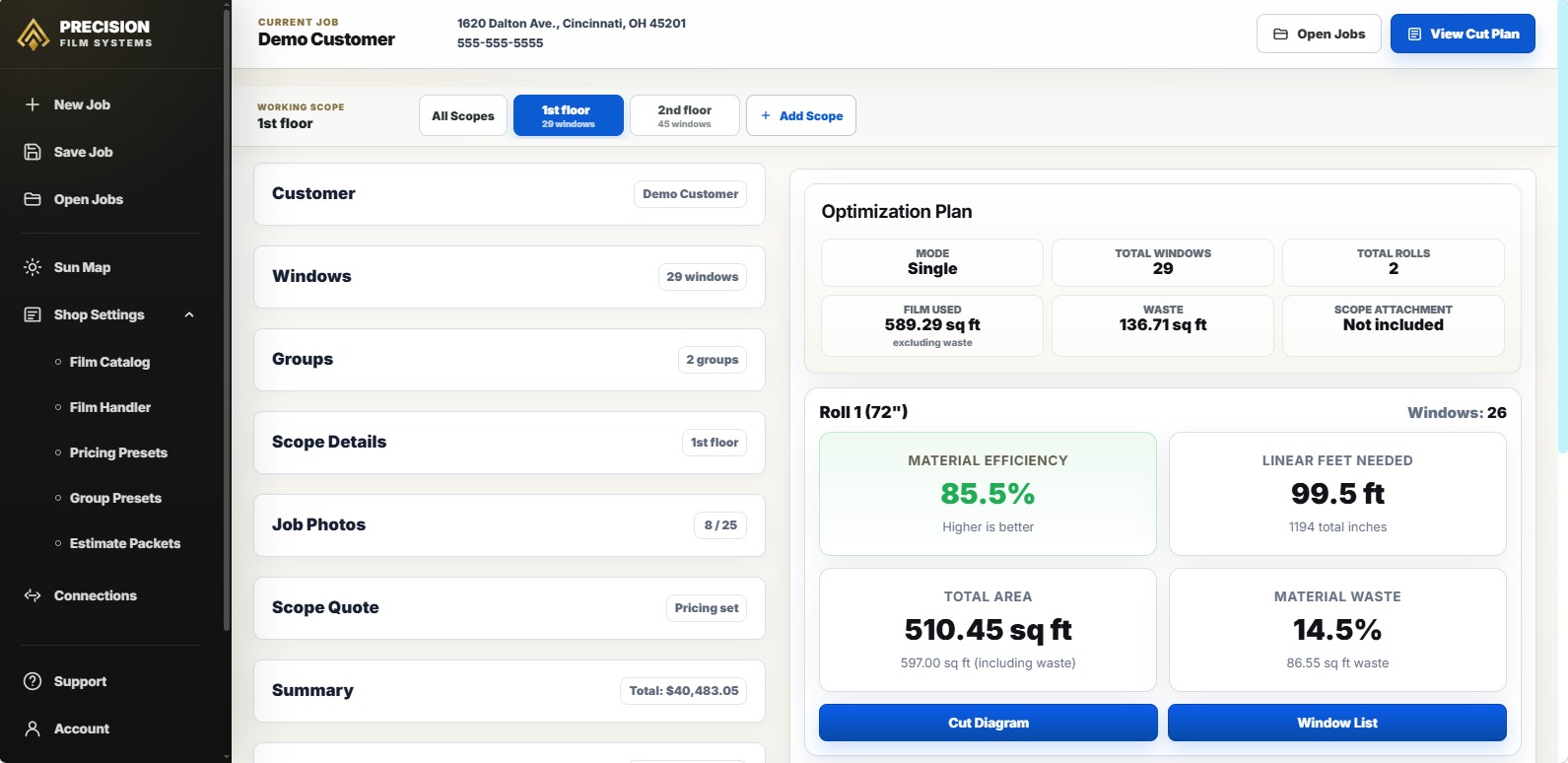
Precision Film Systems helps with the part of the job where the extra film decision becomes visible.
The shop can enter pane sizes, quantities, and film information, then compare roll widths, review the cut layout, see linear feet, and look at waste before deciding what to order or pull.
That does not mean Precision Film Systems decides the final cushion for every job. The installer or shop still has to think about handling, access, availability, replacement risk, and whether leftover film is worth carrying.
The value is that the decision starts from the material plan.
If the layout uses more roll length than the measured square footage suggests, the shop can see that before ordering. If the order increment already leaves useful film, the shop can see that too. If leftover material might help on a future job, Film on Hand mode can bring that material into the planning conversation instead of leaving it on a shelf with no clear role.
Extra film is not a fixed percentage for every job.
It is the difference between the visible material plan and the risk the shop is willing to carry.
Extra film for flat glass jobs
Is 10% extra window film enough for a flat glass job?
Sometimes, but not always. A percentage cushion can work on familiar jobs with clean layouts, but it should not be trusted before the cut layout is checked. Some jobs need less because the order increment already creates a remainder. Other jobs need more because the roll layout, pane mix, access, or film availability creates more risk.
Should extra film be based on square footage or linear feet?
Extra film should be based on the material plan. Square footage tells the shop the measured glass area, but linear feet and roll width show how much film the layout actually pulls from the roll. The extra allowance should be decided after that layout is visible.
Does the supplier order increment count as extra film?
It can create extra material, but it should not be confused with a handling or rework allowance. If a layout uses 36 feet and the shop has to order 50 feet, the remaining 14 feet may provide useful room. Whether that is enough depends on the job conditions.
Is leftover window film the same as waste?
No. Leftover film is only waste if it cannot realistically be used. Remainder left on a roll may still be usable inventory if it is protected, labeled, tracked, and suitable for a future job.
When should a shop order more than the layout requires?
Order more when the job conditions justify it: difficult access, large panes with little room for error, many odd sizes, hard-to-replace film, tight scheduling, future replacement needs, or an order increment that makes the larger purchase more practical.
How does Precision Film Systems help decide how much extra film to order?
Precision Film Systems helps show the material side before the order is made: pane sizes, roll-width comparison, cut layout, linear feet, waste, and leftover material. That gives the shop better information for deciding the extra allowance, while leaving the final decision with the installer or shop.