
A wider roll can be the right answer on a flat glass job. It can reduce required pulls, lower linear feet, avoid seams, or let repeated pane sizes land cleanly.
But wider is not automatically better.
The roll decision still has to be proven by the layout. Pane dimensions, orientation, order increments, leftover material, and offcut usability can all change the answer.
In Practical Terms
A wider window film roll saves material when it helps the actual panes fit the roll more efficiently. It does not save material just because it is wider. If the job does not use the extra width well, the shop may buy more film than needed, leave more remainder on the roll, or create offcuts that are not useful later.
Wider Helps When the Pane Size Fits the Roll
A wider roll earns its keep when it changes the layout in a useful way. That usually happens when the wider width gives the shop a cleaner material result.
| Wider roll helps when | Why it matters |
|---|---|
| More pieces fit across the roll | Fewer required pulls may reduce linear feet |
| A pane can be rotated cleanly | Orientation can change the length used |
| A larger pane avoids a seam | The install may be cleaner and easier to explain |
| Repeated sizes stack efficiently | The cut plan becomes more predictable |
| Offcuts are large enough to reuse | Leftover material may still have value |
That is the good version of a wider roll.
The job uses the width. The layout gets cleaner. The material plan can justify the purchase.
Wider Does Not Help When the Extra Width Is Just Empty Space
The problem is when the wider roll looks better before the panes are laid out.
If a 72" roll still only fits one piece across, and the unused strip beside the pane cannot become another useful piece, the shop may not have saved anything. It may have bought a wider, more expensive roll and still pulled nearly the same length.
That does not mean the wider roll is wrong. It means the layout has to show what the extra width is doing.
| Situation | What can happen |
|---|---|
| Only one pane still fits across | The job uses the same number of pulls |
| Offcuts are too narrow or awkward | The extra width becomes waste |
| Order length stays the same | Lower used length may not change what must be bought |
| The wider roll costs more | Material cost may rise even if linear feet drops |
| Remainder is not tracked | Leftover film turns into uncertain inventory |
| Rotation is not practical | The layout works on paper but not for the job |
That is where shops can get fooled by one number.
Lower linear feet helps, but it is not the whole purchase decision.
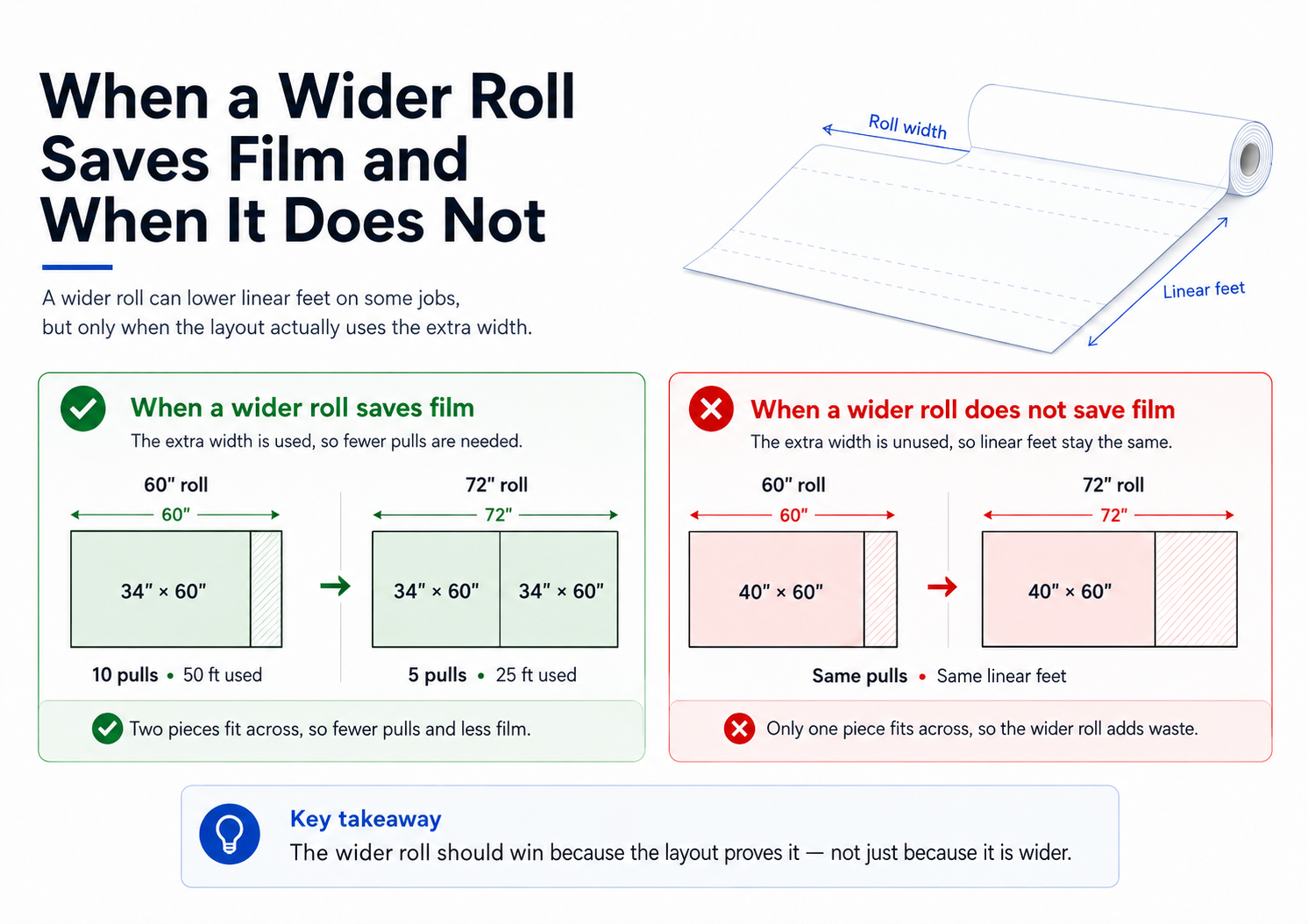
A Simple Roll-Width Example
Take a job with repeated panes:
- 10 panes
- each pane is 34" x 60"
- one selected film
- comparing a 60" roll and a 72" roll
On a 60" roll, one 34" piece fits across. That leaves 26" beside it.
| 60" roll layout | Number |
|---|---|
| Pieces across the roll | 1 |
| Required pulls | 10 |
| Length per pull | 60" |
| Total used length | 600" |
| Linear feet used | 50 ft. |
On a 72" roll, two 34" pieces can fit across.
| 72" roll layout | Number |
|---|---|
| Pieces across the roll | 2 |
| Required pulls | 5 |
| Length per pull | 60" |
| Total used length | 300" |
| Linear feet used | 25 ft. |
Here, the wider roll clearly changes the layout. It cuts the required pulls in half and reduces the roll length used.
That does not finish the buying decision, but it gives the wider roll a real reason to be considered.
Now Look at a Case Where Wider May Not Help
Take a different job:
- 8 panes
- each pane is 40" x 60"
- comparing a 60" roll and a 72" roll
On either roll, only one 40" piece fits across cleanly.
| Roll width | Pieces across | Required pulls | Length per pull | Linear feet used |
|---|---|---|---|---|
| 60" roll | 1 | 8 | 60" | 40 ft. |
| 72" roll | 1 | 8 | 60" | 40 ft. |
The 72" roll did not reduce the length used. It only created a wider unused strip beside each piece.
If that extra strip cannot be used for another pane, a future job, or a planned offcut, the wider roll may just make the job more expensive.
That is the part the square-foot number will not show.
The Order Length Can Change the Decision
Even when the wider roll reduces linear feet, the order length still matters.
A layout might use:
| Option | Linear feet used | Order length | Remainder |
|---|---|---|---|
| 60" roll | 36 ft. | 50 ft. | 14 ft. |
| 72" roll | 30 ft. | 50 ft. | 20 ft. |
The 72" roll uses less length.
But if both options require a 50-foot order, the shop still needs to compare the cost of 50 feet of 60" film against 50 feet of 72" film. The wider roll may leave more remainder, but that remainder only helps if it is usable and tracked.
This is why the material decision should not stop at asking which option uses fewer linear feet.
The better question is: which roll width gives the shop the best usable material result for this job and the next likely use of the leftover film?
Offcuts Matter, but Only If They Are Usable
Some offcuts are useful. Some are just scraps with a nicer name.
A wider roll may create leftover strips that can be used for sidelites, transoms, door glass, small panes, samples, or future work. But that only matters when the dimensions, film type, condition, and labeling are good enough to trust later.
A 14" strip from a 72" roll may be useful on one job and worthless on another. A 20-foot remainder may be valuable if it is protected and recorded. It may be waste if it ends up damaged, unlabeled, or forgotten.
The shop should separate these ideas:
| Material result | Meaning |
|---|---|
| Cut-layout waste | Material lost because of how the pieces fit |
| Offcut | A leftover piece from the layout that may or may not be usable |
| Remainder | Film left on the ordered or pulled roll |
| Usable inventory | Leftover material that is labeled, protected, and realistic to use |
| Waste | Material that cannot realistically be used |
Wider rolls can create better offcuts. They can also create larger waste.
The layout decides which one it is.
Repeated Sizes Can Make Wider Rolls Look Better
Wider rolls often help most when the job has repeated pane sizes.
If a job has twenty identical 34" panes, a 72" roll may let the shop place two pieces across again and again. That kind of repetition is easy to plan, easy to cut, and easy to verify.
Mixed sizes are different.
A storefront may have large glass, door glass, sidelites, and transoms. The wider roll might help with the big panes but create awkward waste around the smaller pieces. Or the smaller pieces might make good use of the offcuts from the larger cuts.
That is why the job should be grouped before the roll decision is made. Do not compare roll widths from one square-foot total. Compare them from a pane list with sizes, quantities, film types, and areas.
Orientation Has to Be Practical
A wider roll may only save material if the pieces can be rotated.
That can be a good answer. It can also be a bad assumption.
Before relying on rotation, the shop should think through the film, the job, and the install. Roll direction, appearance, handling, manufacturer guidance, installer preference, and the final cut plan may all matter depending on the product and situation.
A rotated layout is only useful if the shop is comfortable cutting and installing from it.
The goal is not to make the numbers look clever. The goal is to produce a material plan that works in the real job.
What to Check Before Choosing the Wider Roll
Before deciding that the wider roll saves film, check the material side clearly.
| Check | Why it matters |
|---|---|
| Pane sizes and quantities | A wrong count makes the roll comparison useless |
| Roll widths actually available | The best theoretical roll may not be orderable |
| Pieces across each roll | This shows whether width changes the layout |
| Required pulls | Fewer pulls may reduce linear feet |
| Length per pull | Rotation can change this number |
| Order length | Used length and purchased length may differ |
| Cut-layout waste | Empty strips and unusable gaps affect margin |
| Remainder | Leftover roll length may still be inventory |
| Offcut usability | Extra width only helps if the leftover pieces matter |
| Practical cut plan | The layout has to work for the person cutting and installing |
A wider roll should be chosen because the job proves it, not because it sounds safer.
Common Mistakes
One common mistake is assuming the wider roll is automatically more efficient. Sometimes it is. Sometimes it only creates a wider unused strip.
Another mistake is chasing the lowest linear-foot number without checking order length. If both roll widths require the same purchase length, the wider roll may cost more even though the layout uses less length.
A third mistake is counting every leftover piece as useful. Offcuts only matter if they can realistically be used. If nobody knows the film type, roll width, remaining length, age, condition, or location later, that leftover is not dependable inventory.
The larger mistake is making the roll decision before the cut layout is visible. The layout is where the assumption gets tested.
How Precision Film Systems Fits Into This
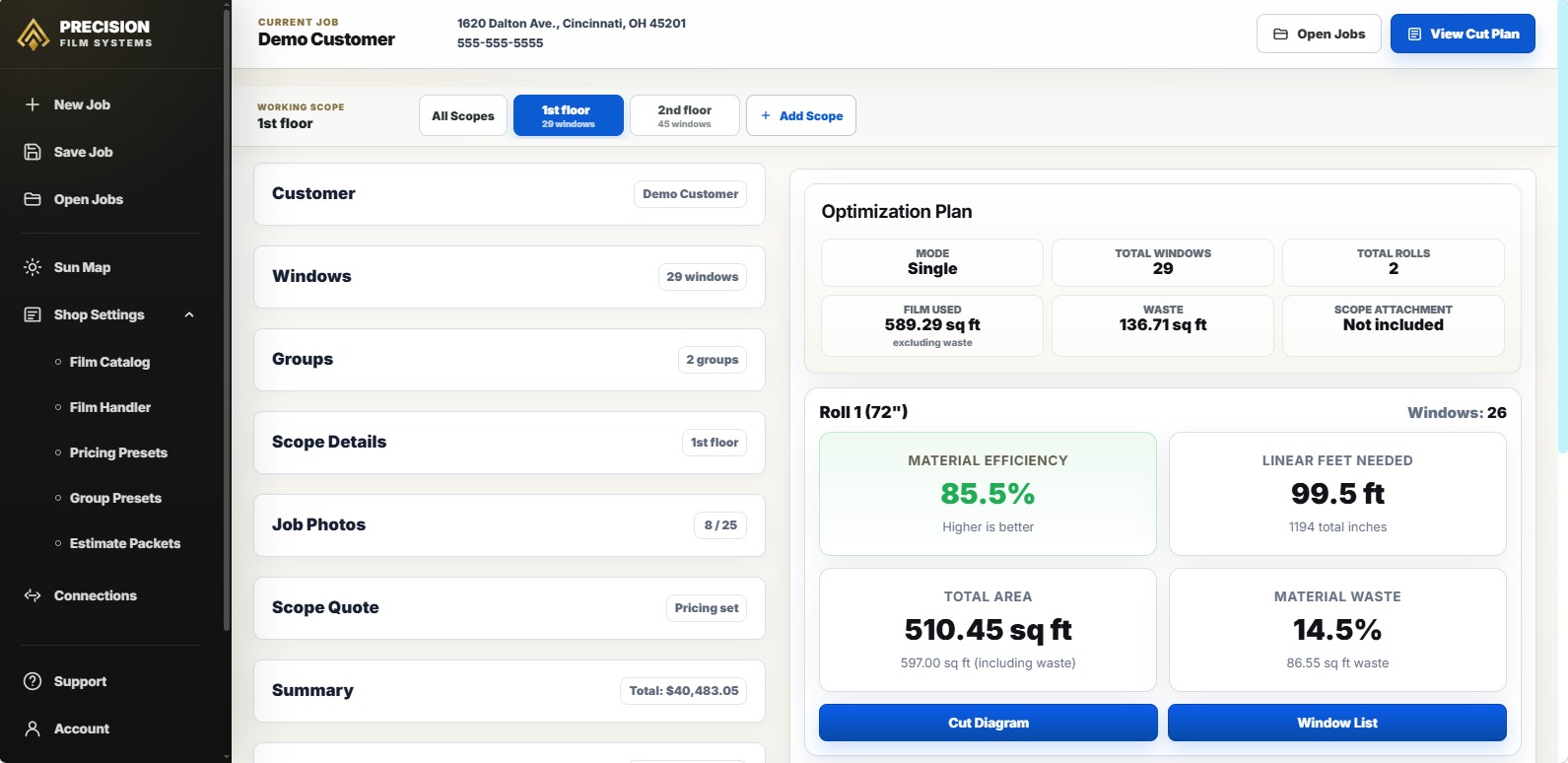
Precision Film Systems helps with the part of the job where a roll-width assumption needs to become a visible comparison.
The shop can organize pane sizes, quantities, film type, roll-width options, orientation, linear feet, waste, and cut-layout information before the quote or order gets too far ahead.
The wider roll may be the better answer, but it should not win by default.
Precision Film Systems helps show whether the wider roll reduces required pulls, lowers usable length, changes the order decision, creates waste, or leaves material that may be useful later. If leftover film is part of the decision, Film on Hand mode can help bring that material into the next job instead of leaving it as a loose memory.
The point is simple: run the comparison before trusting the roll choice.
Wider rolls and flat glass window film waste
Does a wider window film roll always reduce waste?
No. A wider roll only reduces waste when the pane sizes and layout make use of the extra width. If the job still only fits one piece across and the leftover strip is not useful, the wider roll may not save material.
When does a wider roll usually help?
A wider roll usually helps when it lets more pieces fit across the roll, allows a practical rotation, avoids seams, reduces required pulls, or creates offcuts that the shop can realistically use.
Can a narrower roll be more efficient?
Yes. A narrower roll can be the better choice when it fills the width cleanly, costs less to purchase, creates less unusable leftover material, or works better with the order length.
Is lower linear footage always the better roll choice?
No. Lower linear footage is useful, but the shop still has to compare roll width cost, order increments, remainder, waste, availability, and whether the cut plan is practical.
How should a shop decide between roll widths?
Start with the actual pane list, then compare the available roll widths by layout, required pulls, linear feet, order length, waste, remainder, and offcut usability. The wider roll should win only when the material plan supports it.