
Small panes can make a flat glass job look harmless on the measurement sheet. The total square footage may be modest, the individual pieces may be easy to handle, and nothing about the job looks especially difficult at first glance.
The material side can tell a different story.
A job with many small panes can create more waste than expected because the pieces have to repeat across the roll over and over again. If the pane size does not fit cleanly against the roll width, the same strip of unused film can repeat through the whole layout.
In Practical Terms
Small panes create waste when the pieces do not fit the roll width cleanly, when trim allowance repeats across many individual panes, or when the offcuts are too small or awkward to use later. The square footage may be low, but the layout can still require more pulls, more handling, and more unusable material than the glass number suggests.
The Total Square Footage Can Be Misleading
Square footage is still useful. It tells the shop how much glass is being covered and gives the quote a starting point.
But square footage does not show how many individual pieces have to be cut.
That matters on small-pane jobs because the roll does not care about the total. It cares about the piece sizes, the roll width, the direction those pieces can run, and how many times the same cut has to repeat.
A job with twelve large panes may have the same measured glass area as a job with forty small panes. On paper, those jobs can look similar. On the roll, they are not the same job.
The small-pane job may need more repeated pulls. It may leave the same unused strip beside every group of pieces. It may create offcuts that look like material but are not realistic to use on another job.
That is where waste starts to grow.
Small Panes Repeat the Same Problem
One awkward pane size is not usually the issue. The issue is repetition.
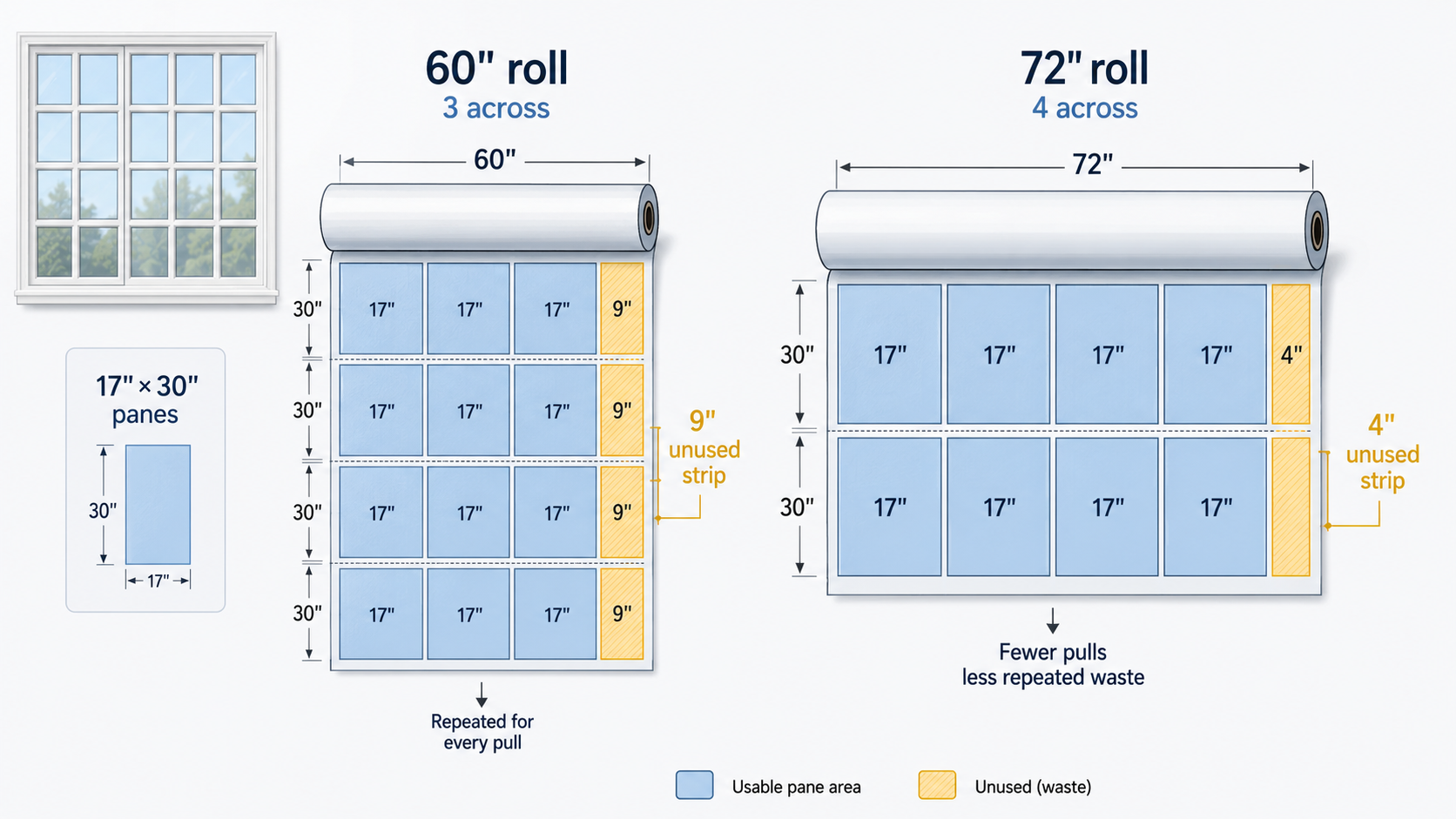
If a 17" wide pane leaves an awkward strip on a 60" roll, that strip does not show up once. It can show up pull after pull, especially when the job has a large count of the same size.
For example:
| Job detail | Example |
|---|---|
| Pane size | 17" x 30" |
| Quantity | 24 panes |
| Roll width tested | 60" |
| Pieces across the roll | 3 pieces, using 51" |
| Unused width each pull | 9" |
| Required pulls | 8 pulls |
| Approximate layout length | 20 linear feet before extra allowance |
That 9" strip may not seem like much by itself. But repeated across the layout, it becomes real material. It also may not be useful inventory. A narrow strip can be hard to protect, label, store, and reuse in a way that actually helps the next job.
The same job may look different on another roll width. A 72" roll might fit four 17" pieces across, using 68" and leaving only a 4" strip. It may also reduce the number of pulls.
That does not automatically make the 72" roll the better purchase. The wider roll may cost more, may have a different order increment, and may leave a different remainder after the job is cut. But the example shows the point: the waste is hiding in the fit, not just in the total square footage.
Trim Allowance Adds Up Faster on Small Pieces
Small panes also repeat trim and handling allowance more often.
That does not mean the shop should skip proper allowance. The film still has to be cut and installed correctly. The point is that a job with many individual panes has more edges, more pieces, and more chances for small allowances to add up.
A few large panes may have fewer total cuts and fewer repeated allowances. A job full of divided lites, sidelites, interior office panes, or small transoms may have the same square footage spread across many more pieces.
The glass area may be modest. The material behavior may not be.
Offcuts Are Not Automatically Usable
This is where small-pane jobs can get misunderstood.
Some offcuts are useful. If the remainder is large enough, clean enough, labeled, protected, and easy to match to another job, it may still have value. That is not waste in the same way as scrap on the floor.
But small-pane layouts often create narrow strips or odd leftovers that are technically film but not realistic inventory.
A strip may be too narrow for most future panes. It may be difficult to store without damage. It may not match the next job's film type, roll width, orientation, or appearance needs. It may sit around until someone finally throws it away.
That is why waste and remainder should stay separate in the planning conversation.
Cut-layout waste is material lost because of how the pieces fit inside the layout. Remainder is film left on the ordered or pulled roll after the job is planned or cut. Some remainder can become usable inventory. Some offcuts are just waste with a delay.
The Roll Width Decision Matters
Small panes are a good reminder that roll width is not only about big glass.
A wider roll may help if it allows more pieces across, reduces required pulls, or turns an awkward repeated strip into a cleaner layout. A narrower roll may work better if the panes fit it cleanly and the order length or purchase cost makes more sense.
The weak move is assuming the answer before the layout is visible.
For small-pane jobs, the shop should be asking:
| Question | Why it matters |
|---|---|
| How many pieces fit across each roll width? | Shows whether waste repeats through the layout |
| How many required pulls does each option need? | Affects linear feet and cutting workflow |
| Are the offcuts realistically usable? | Separates true remainder from wishful inventory |
| Does the wider roll actually improve the job? | Prevents buying more width without a payoff |
| What order length is required? | Used length and purchased length are not always the same |
The best roll width is not always the widest one. It is the one that makes the material plan, cost, layout, and install workflow make the most sense together.
This Can Affect the Quote
Small-pane waste matters most when the quote is built from a clean square-footage number and the material side is checked later.
The quote may look fine when the job is measured. Then the layout gets built, and the shop sees that the job needs more film than expected, leaves more unusable offcut than expected, or requires a different roll width than the quote assumed.
That does not mean the job was measured wrong. It means the square footage did not show the whole material decision.
A small-pane job can still be profitable. It just needs to be priced and planned with the layout in mind.
What to Check Before Ordering or Quoting Too Far Ahead
Before trusting the material number on a small-pane job, check the pane count, not just the square footage. A size that appears once is different from a size that appears thirty times.
Then compare the likely roll widths. Look at how many pieces fit across, how many pulls are required, and whether rotation is allowed or useful for that film and job.
Also look at the offcuts honestly. If the leftover material is large, clean, labeled, and likely to be used later, it may have inventory value. If it is a narrow strip that will probably sit in the shop until it gets damaged or tossed, treat it like waste.
The goal is not to make every small-pane job complicated. The goal is to avoid letting a modest square-footage total hide a waste-heavy layout.
Where Precision Film Systems Fits
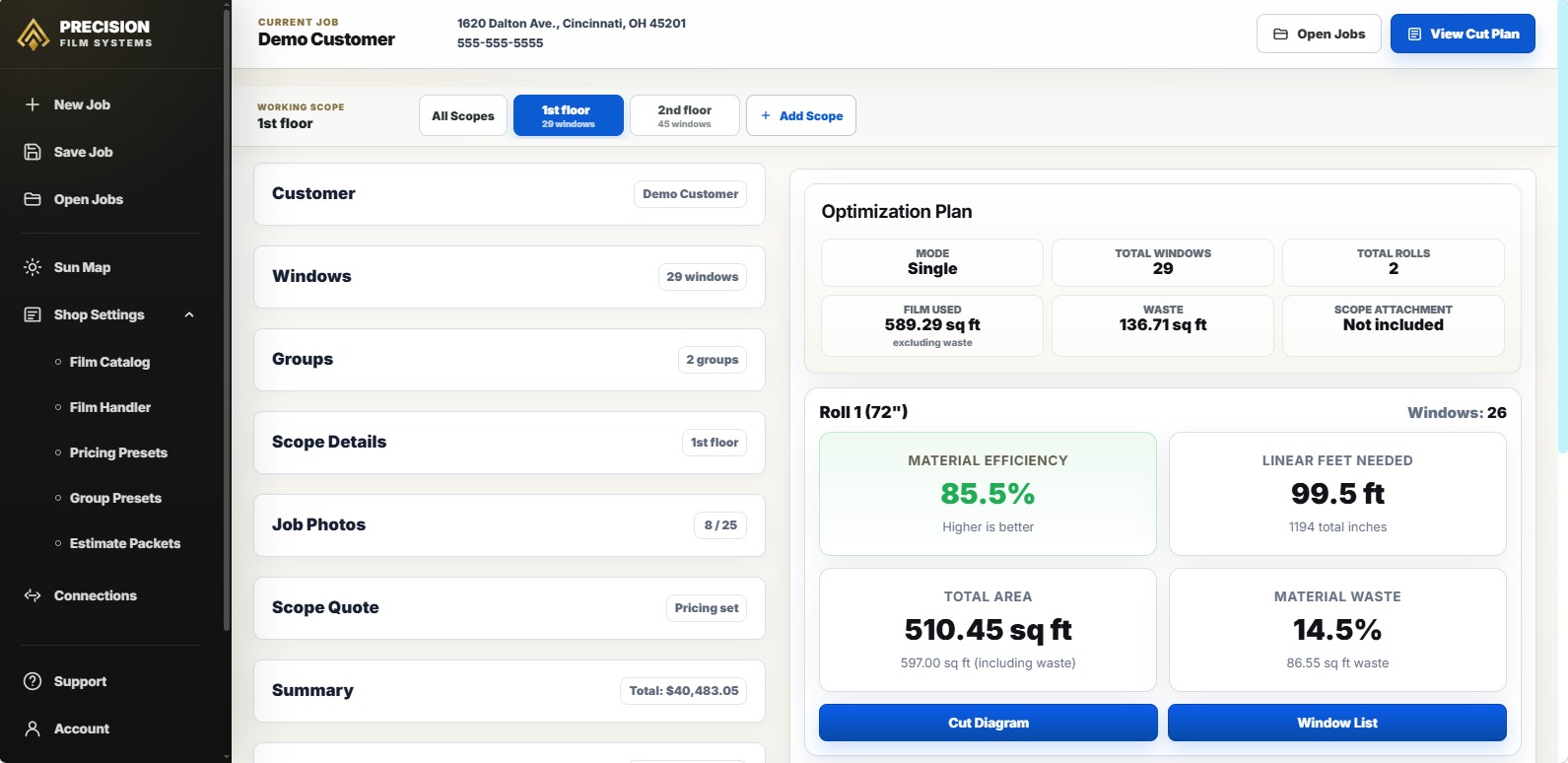
Precision Film Systems helps make this part visible before the job gets too far along.
You can enter the pane sizes and quantities, compare standard roll widths, review linear feet, and see how the cut layout affects waste. That gives the shop a better way to check whether a small-pane job is clean, awkward, or worth testing against another roll width.
The software does not replace field judgment. A shop may still choose a layout with a little more waste because it is easier to cut, easier to install, or better for the handoff.
The value is seeing that tradeoff early enough to make the decision on purpose.
Small panes are not automatically a problem. Hidden waste is the problem. Once the layout is visible, the shop can decide whether the material plan supports the quote.
Small panes and window film waste
Why can small panes create more window film waste?
Small panes can create more waste because the same fit problem may repeat across many pieces. If the pane size leaves an unused strip on the roll, that strip can repeat through the whole layout.
Is square footage enough to plan a small-pane flat glass job?
Not by itself. Square footage shows the measured glass area, but the material plan still depends on pane size, quantity, roll width, orientation, linear feet, cut-layout waste, and usable remainder.
Does a wider roll always reduce waste on small panes?
No. A wider roll can help if it lets more pieces fit across or reduces required pulls, but it can also cost more or leave a remainder that is not useful. The layout has to prove the decision.
Are small offcuts considered waste?
Often, yes. Some offcuts can be usable inventory, but narrow or awkward strips are usually hard to protect, track, and reuse. If the shop cannot realistically use the offcut later, it should be treated as waste.
How should shops handle small-pane jobs before quoting?
Build or review the cut layout before the quote gets too far ahead. Compare roll widths, check required pulls, review likely waste, and decide whether the offcuts or remainder have real future value.