
A flat glass job can be measured carefully and still be hard to plan if the wrong details are missing.
The issue is not only whether the tape measure number is close. The material plan depends on pane sizes, quantities, orientation, film type, access notes, repeated sizes, and how the pieces will land on the roll.
A small measurement mistake can change the quote, the order length, the cut layout, or the amount of leftover film.
In Practical Terms
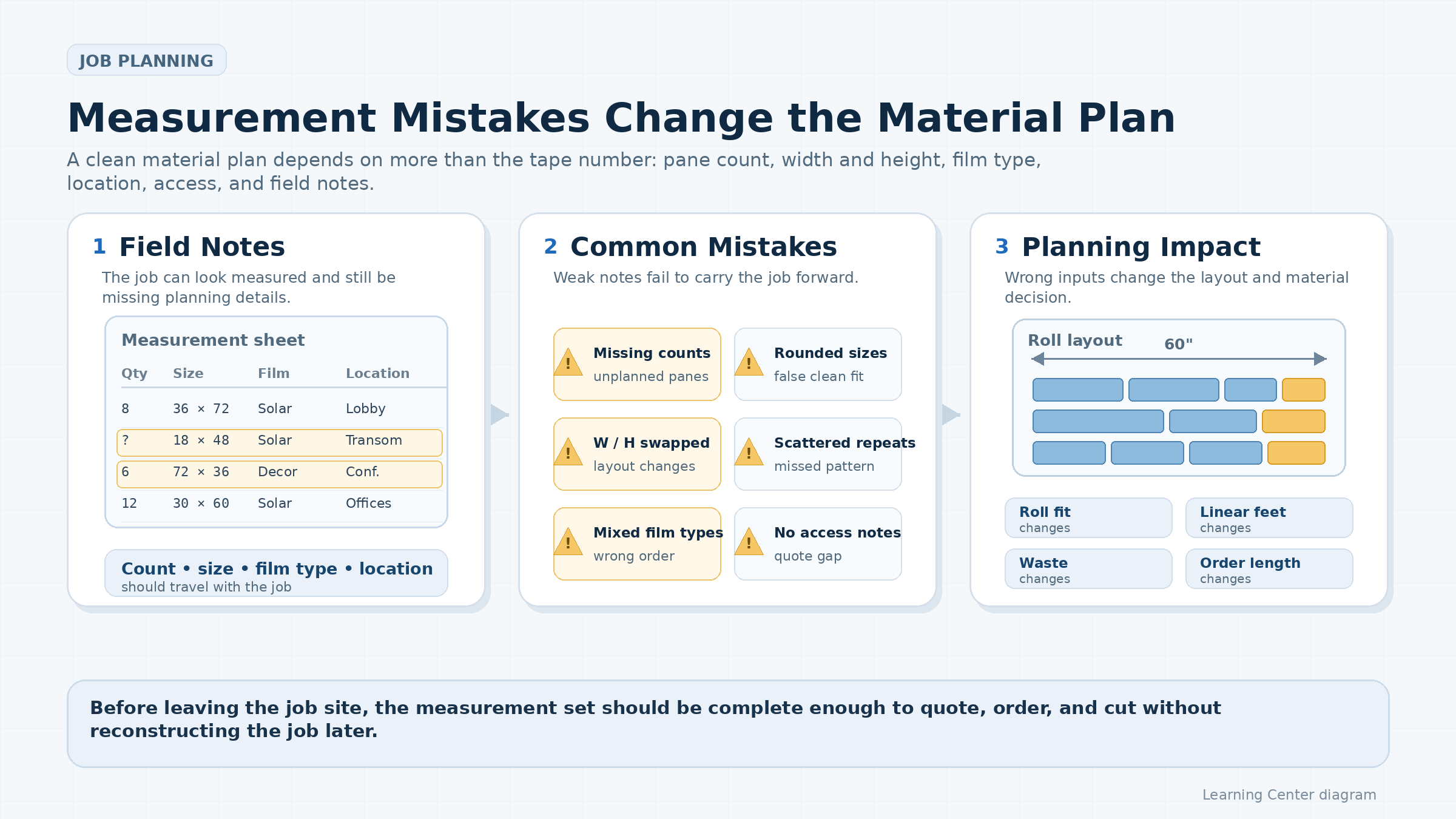
The most common window film measurement mistakes are missing pane counts, rounded measurements, swapped width and height, unclear repeated sizes, missing obstruction notes, and mixing film types together. Each one can make the material plan look cleaner than it really is. Before leaving the job site, the measurements should be complete enough to build a quote, order film, and cut the job without guessing later.
Measurements Are Not Just Job Notes
Measurements are the starting point for the whole material side of the job.
They feed the square footage, but they also feed the roll-width decision, linear feet, cut layout, order length, waste estimate, and job handoff. If the measurements are incomplete, the downstream numbers can still look polished while being wrong underneath.
That is why a measurement mistake is not always obvious at the measuring stage. It usually shows up later, when the shop is trying to quote the job, compare roll widths, order film, or explain the cut list to the installer.
For a cleaner measurement workflow, the job-site notes should connect back to the same information covered in What to Write Down Before You Leave the Job Site and How to Turn Window Measurements Into a Material Plan.
Common Measurement Mistakes
| Mistake | What it changes later |
|---|---|
| Missing pane counts | The job may be short on material even if every recorded pane is measured correctly |
| Rounded measurements | The cut layout may be built around numbers that are too clean to trust |
| Swapped width and height | Roll-width fit, orientation, and linear feet can change |
| Repeated sizes not grouped clearly | The shop may miss layout efficiency or cut repeated panes inconsistently |
| Obstructions not noted | Access, removal, ladder work, or cut decisions may be discovered too late |
| Film types mixed together | The material plan may combine products that need separate orders |
| Locations left vague | The installer may not know which pane belongs where |
| Existing film or removal missed | Labor and material handling can be underquoted |
| Fractional measurements unclear | A small notation issue can become a recut or field question |
| Changes after measuring not captured | The quote and cut plan may no longer match the job |
The problem is not that every measurement has to become a long report. The problem is that the measurement set has to carry the job after the estimator leaves the glass.
Missing Pane Counts
A missing pane count is one of the easiest mistakes to make because the measured windows can all be correct.
The issue is the panes that never made it onto the list.
A storefront may have eight large lites, two doors, two sidelites, and a row of transoms. If the transoms are missed or the door glass is treated like a note instead of a measured item, the square footage, film order, and cut list all start from the wrong job.
Missing counts affect:
| Planning area | Why it matters |
|---|---|
| Quote | The job may be priced below the real scope |
| Material plan | Film needed may be short before waste is even considered |
| Cut layout | The layout may not include every piece |
| Install handoff | The crew may find unplanned glass on site |
| Schedule | Missing pieces can create a return trip or second order |
Pane count should be checked by room, elevation, opening type, or section before the job-site notes are trusted.
Rounded Measurements
Rounding can make a messy job look clean.
That is convenient in the notebook, but it can cause trouble when the film has to be cut. A measurement written as 36" x 72" might really be 35 7/8" x 71 5/8", or it might be 36 1/4" x 72 3/8". Those differences may not seem large while measuring, but they can matter when pieces are nested on the roll or when trim allowance is being decided.
Rounded measurements can also hide repeated-size differences. A group of panes that all look like 30" x 60" may not actually cut the same if some are slightly taller, wider, or out of square.
The safer habit is to record the real measurement, then let the material plan decide how much working room, trim, or handling allowance belongs on the cut.
Swapping Width and Height
Swapping width and height is not just a labeling issue.
A 36" x 72" pane and a 72" x 36" pane may have the same measured glass area, but they do not behave the same on the roll. Depending on roll width and orientation, one may fit cleanly while the other forces a different pull, creates more waste, or changes whether a wider roll is worth considering.
That is the same reason square footage alone is not enough.
When measurements are written in the field, width and height should stay consistent across the whole job. If the shop uses width first, every pane should follow that habit. If a piece needs special orientation because of pattern, film direction, seams, or appearance, that should be called out separately.
Not Grouping Repeated Sizes
Repeated sizes are valuable when they are visible.
If the same pane size appears twenty times but is scattered across rough notes, the shop may miss how cleanly those pieces can be planned. That can affect roll-width comparison, cut sequence, labeling, and how confidently the installer can work from the cut list.
Repeated sizes should still keep location notes. The goal is not to erase where each pane belongs. The goal is to make the pattern clear enough that the material plan can use it.
A useful measurement set shows both:
| Detail | Why it matters |
|---|---|
| Repeated size and quantity | Helps with layout, ordering, and cutting |
| Location or room note | Helps the installer place the pieces correctly |
For example, "30 x 72, qty 12" is useful for planning. "Offices 101-106, two per office" makes it useful in the field.
Not Separating Film Types
A job with more than one film should not be measured as one blended total.
Different products may have different roll widths, costs, availability, handling concerns, and waste behavior. Solar control film, decorative film, safety film, and exterior film should each have their own measurement group and material decision.
If the measurements are combined too early, the quote may look simpler than the job really is. The shop may also miss that one film needs a 60" roll while another product is only being considered in a different width or order increment.
Separate the glass by film type before building the material plan. Then each product can have its own roll-width comparison, cut layout, waste review, and order length.
Not Noting Obstructions or Access Issues
A measurement can be accurate and still be incomplete.
Obstructions do not always change the pane size, but they can change the work. Furniture, mullion depth, high glass, tight corners, alarm contacts, blinds, security hardware, deep frames, and limited ladder access can all affect how the job is quoted, scheduled, cut, or installed.
These notes matter because they help explain why a job may need more handling time, more caution, or a different installation plan.
A clean measurement set should leave room for short field notes such as:
- deep frame
- ladder needed
- blinds to remove
- desk built in front of glass
- existing film removal
- alarm contact
- pattern direction matters
- verify glass label
- customer wants this room excluded
Those notes do not need to be fancy. They need to be visible when the job is being planned.
A Simple Pre-Exit Check
Before leaving the job site, the estimator or installer should be able to answer these questions:
| Check | Why it matters |
|---|---|
| Did every pane make it onto the list? | Prevents missing material and scope |
| Are width and height recorded consistently? | Keeps roll layout and orientation clean |
| Are quantities clear? | Prevents undercounting repeated panes |
| Are repeated sizes grouped or easy to find? | Helps cut planning and roll-width comparison |
| Are film types separated? | Keeps each product order accurate |
| Are rooms, elevations, or locations noted? | Makes the handoff easier to use |
| Are obstructions and removal noted? | Protects the quote and install plan |
| Are unusual panes called out? | Keeps odd pieces from being treated like standard repeats |
| Are photos tied to the notes? | Helps reconstruct the job later |
| Are compatibility concerns still visible? | Keeps film selection review separate from material planning |
This is the point where the job still makes sense visually. Once the estimator leaves, the notes have to do the work.
How Precision Film Systems Fits Into This
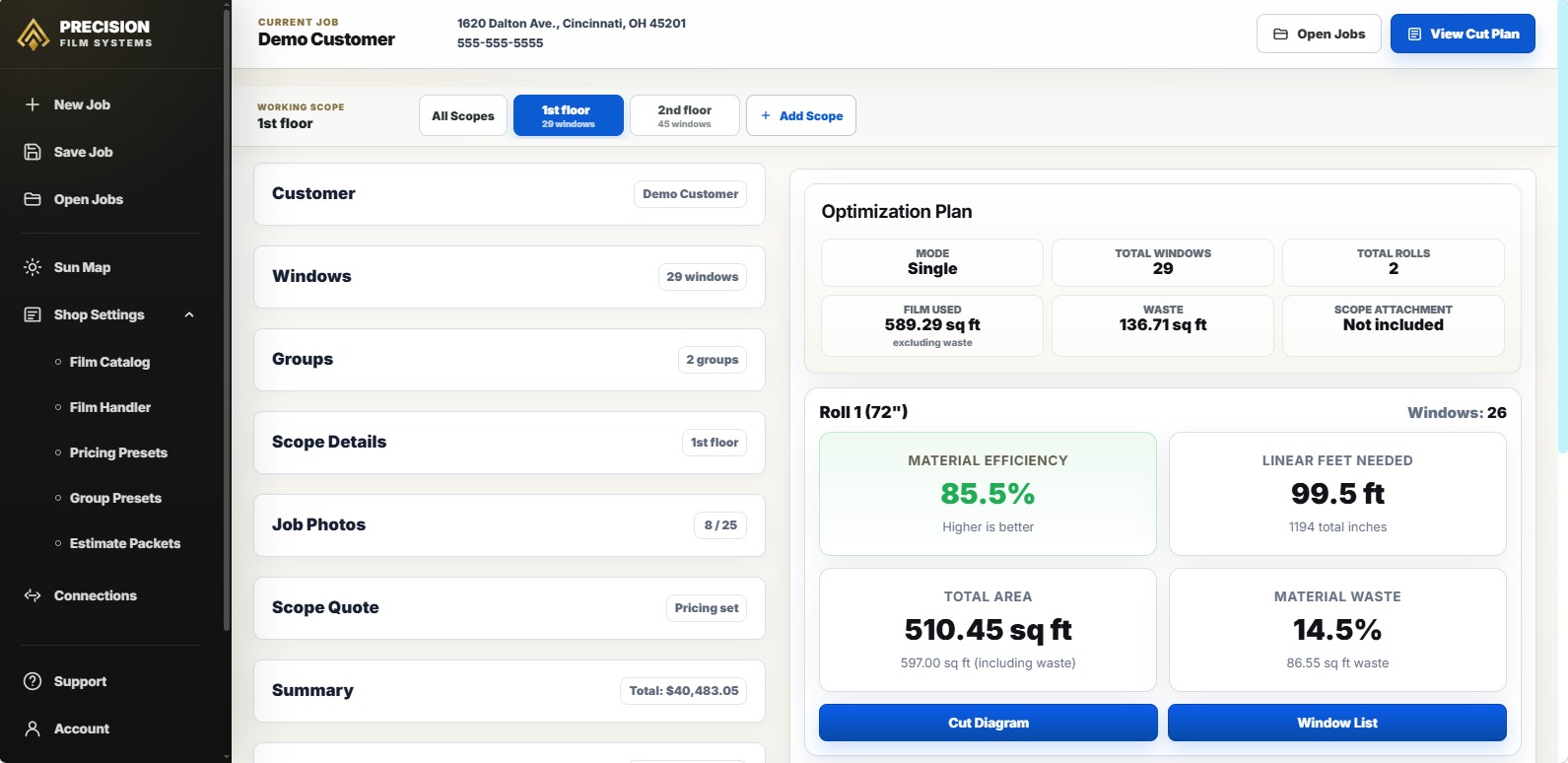
Precision Film Systems can help turn pane sizes, quantities, film information, roll widths, linear feet, waste, and cut layout into a visible material plan.
But the output is only as useful as the information entered into it.
If a pane count is missing, the layout will not know it. If film types are blended together, the order decision can get muddy. If width and height are swapped, the roll-width comparison may be working from the wrong shape.
The value of a consistent measurement workflow is that it gives the planning step something solid to work from. Once the job information is clean, Precision Film Systems can help show how the material side behaves before the quote, order, or cut list gets too far ahead.
Flat glass measurement mistakes
What are the most common window film measurement mistakes?
The most common mistakes are missing pane counts, rounding measurements too much, swapping width and height, failing to group repeated sizes, mixing film types together, and leaving out access or obstruction notes.
Why do small measurement mistakes change how much film a job needs?
Window film is planned from individual pane sizes, quantities, roll width, orientation, and cut layout. A small mistake can change how the pieces fit on the roll, how many linear feet are needed, or whether the shop orders enough material.
Is square footage enough if all the windows were measured?
No. Square footage shows measured glass area, but it does not show roll fit, required pulls, waste, order length, film type separation, or how the cut layout should be built.
Should repeated pane sizes be written once or listed individually?
Both details matter. Group repeated sizes so the material plan can use the quantity clearly, but keep enough room, elevation, or location notes so the installer knows where those pieces belong.
Why should film types be separated during measuring?
Each film may have its own roll width, cost, availability, handling needs, and waste profile. Combining multiple products into one measurement total can make the order and cut plan wrong.
How does Precision Film Systems help with measurement mistakes?
Precision Film Systems helps organize pane sizes, quantities, film types, roll-width comparisons, linear feet, waste, and cut layouts. It can make planning problems easier to see, but the original measurement set still needs to be complete and consistent.