
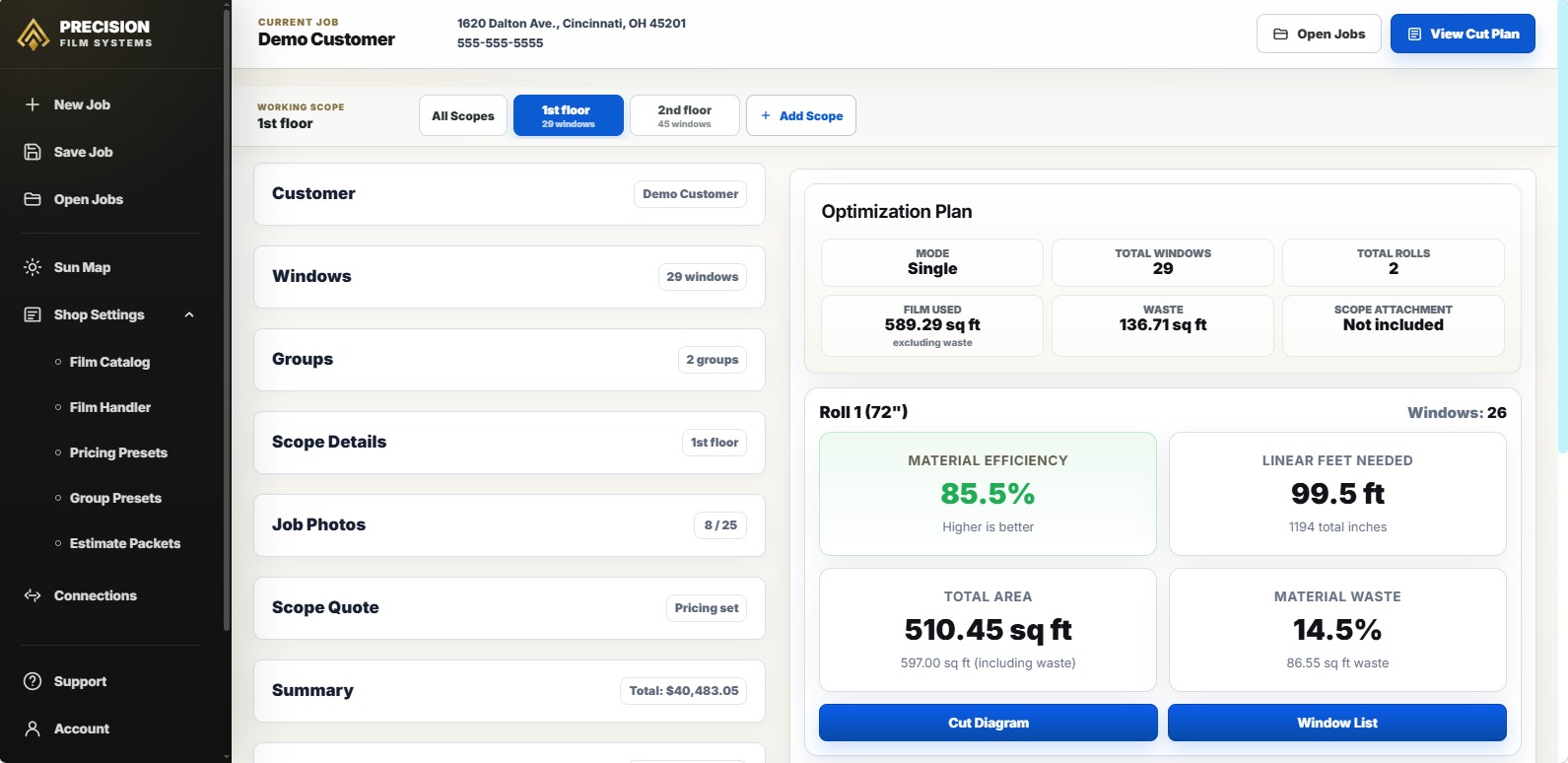
Flat glass cut planning starts with the measured panes.
Flat glass jobs often include repeated panes, odd transoms, sidelights, doors, room groups, and mixed sizes that do not behave the same way once they are placed on a roll. Precision Film Systems helps shops compare how those measurements fit different roll widths so the material decision is based on layout, not square footage alone.
Square footage tells you the glass area. It does not tell you the best roll-width path, the linear feet the layout needs, or which cut plan is easiest to hand to the crew. If you want to test that workflow against a job your shop already finished, start with the window film cut planner demo.
The pane list carries the real planning work.
Architectural film jobs are measurement-heavy. A useful flat glass cut optimizer has to keep pane size, quantity, group, film, roll width, and layout connected from the first plan through the handoff.
Pane sizes and quantities
Repeated sizes, odd panes, doors, sidelights, transoms, and room groups stay visible instead of getting flattened into one square-foot total.
Groups and job structure
Room, elevation, phase, or area groups help the cut plan stay useful after quoting, ordering, cutting, and crew handoff.
Roll-aware output
The same pane list can produce roll-width comparisons, linear-foot numbers, waste visibility, cut diagrams, and window lists.
How Precision Film Systems fits a tint shop that handles both.
Automotive tint tools can be excellent for vehicle work. Precision Film Systems does not replace those tools or provide vehicle patterns. It gives the same shop a purpose-built workflow for the residential and commercial flat glass jobs that start from field measurements.
No vehicle pattern library
Architectural panes are measured from the building, then organized by area, room, elevation, film type, and quantity.
The roll-width decision is central
A flat glass shop often needs to compare 36, 48, 60, and 72 inch film before quoting, ordering, pulling from stock, or cutting.
The output has to travel
Cut diagrams, window cut lists, job details, and project output help the plan move from the person who measured it to the person cutting or installing it.
Generic nesting software can pack shapes, but the shop still needs a film plan.
A generic nesting tool may help place rectangles on a sheet or roll. Flat glass film planning needs the surrounding shop context too: pane groups, roll widths the film is actually sold in, fit warnings, linear feet, cut-layout waste, order length, usable remainder, and output the crew can follow.
The goal is not only to place pieces tightly. The shop needs to decide which material path is practical for the job.
Compare 36, 48, 60, and 72 inch film before ordering.
This example uses one 19-pane flat glass job with 251.78 square feet of measured glass. The 36 inch result is not a full-job option because four panes do not fit that width. The other widths all work, but they produce different linear-foot and waste results.
The 72 inch roll wins in this example. That does not make 72 inch film the automatic answer on the next job. Material cost, order length, handling, film on hand, and usable remainder still belong in the final decision.
| Roll option | Fit result | Linear feet | Cut-layout waste | Planning note |
|---|---|---|---|---|
| 36 inch roll | 15 of 19 panes | 69.0 ft | 18.1% | Warning result: four panes do not fit this roll width. |
| 48 inch roll | 19 of 19 panes | 88.7 ft | 29.0% | Valid result, but highest length and waste in this comparison. |
| 60 inch roll | 19 of 19 panes | 64.2 ft | 21.5% | Valid result with less length and waste than the 48 inch option. |
| 72 inch roll | 19 of 19 panes | 48.3 ft | 13.0% | Best visible layout result in this example. |
The selected layout should be ready for handoff.
Once a roll-width option is selected, the plan still has to support the next step. Precision Film Systems keeps the material comparison connected to output the shop can use for ordering, pulling from stock, cutting, and install prep.
-
Measured pane list
Keep width, height, quantity, film, and groups in the same job record.
-
Roll-width results
Review fit, linear feet, efficiency, waste percentage, and waste square footage.
-
Cut diagrams
See how pieces land on the selected roll width before the job moves into cutting.
-
Window cut lists
Carry the pane details forward so the crew is not working from a loose square-foot number.
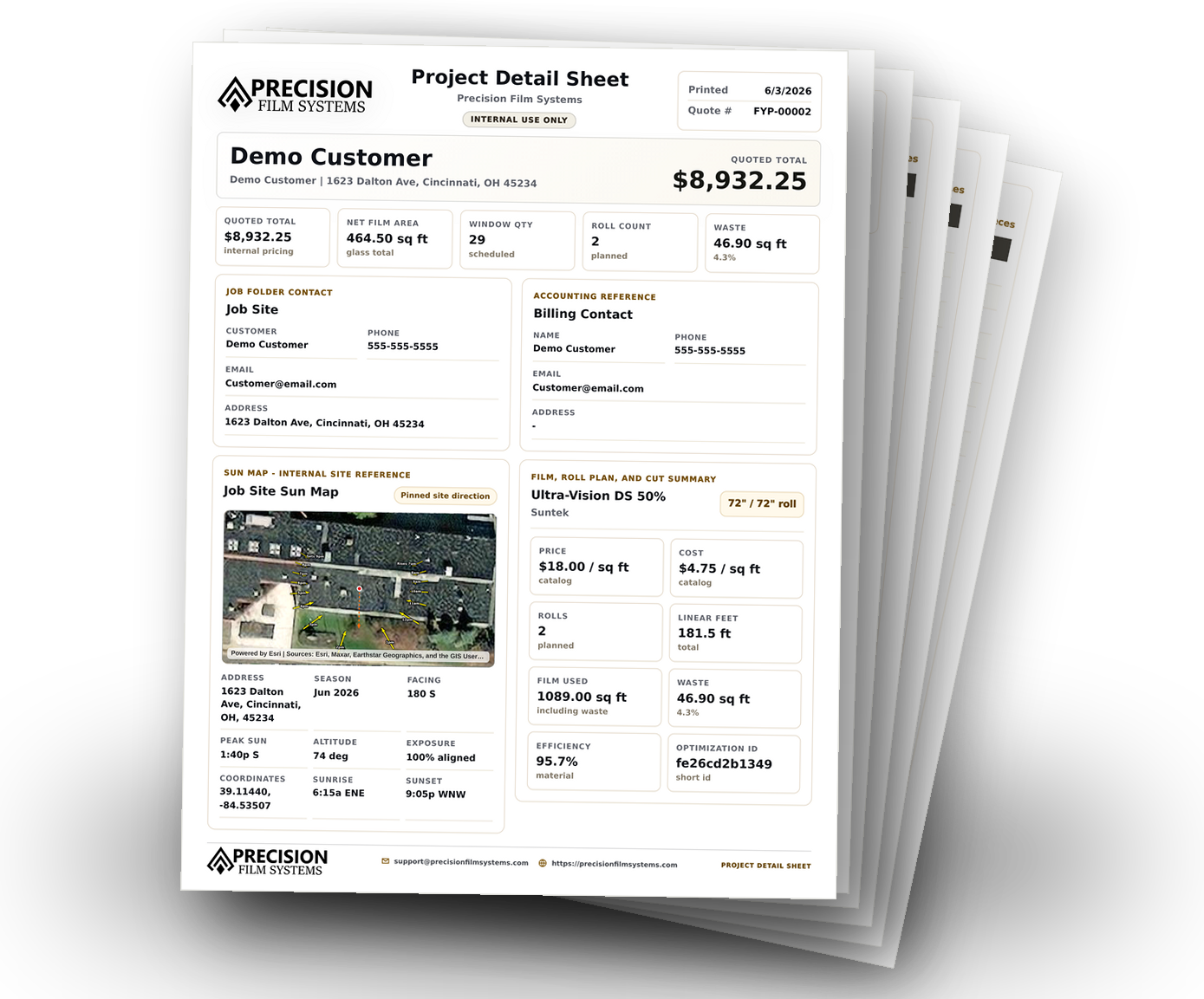
A planning layer between measurement and production.
Flat glass cut planning sits between the field measurements and the material decision. Precision Film Systems helps organize pane sizes, quantities, groups, film details, roll-width comparisons, linear feet, waste, and layout output in that middle part of the job.
With Shop, measured project data can be reused across independent Scopes, selected films, exact estimate revisions, recorded customer responses, Film Handler planning, and verified output. Optional tools include finite Film on Hand, the user-managed Film Catalog, pricing and tax presets, Job Photos, and Sun Map. Generated production output checks plan currentness, while finalized estimates remain revision snapshots. The app does not approve compatibility or make the final field call. It gives the material decision a clearer place to live.
- Compare standard roll widths from the same architectural pane list.
- Review linear feet, fit warnings, material efficiency, and cut-layout waste.
- Keep cut diagrams and window lists ready for ordering, cutting, or install prep.
- Separate cut-layout waste, remainder, usable inventory, and true waste when the job calls for it.
Use it when architectural cut planning needs a roll-aware view.
Good fit for
- Flat glass shops comparing 36, 48, 60, and 72 inch roll-width options.
- Automotive tint shops that also do-or are preparing to add-residential and commercial flat glass.
- Installers who plan around room groups, elevations, repeated panes, doors, sidelights, and transoms.
- Teams that need cut diagrams, window lists, and project output to support handoff.
Not meant to be
- An automotive tint pattern library or vehicle-template workflow.
- A generic nesting package for every material, machine, or fabrication process.
- A promise that one roll width is always best, or that every source of waste can be removed.
- A replacement for installer judgment, compatibility review, or manufacturer guidance.
Questions shops ask about flat glass cut optimization.
Short answers for shops comparing architectural window film cut planning tools, automotive tint workflows, generic nesting software, and roll-aware material planning.
What is a flat glass cut optimizer?
A flat glass cut optimizer helps turn measured architectural window film panes into roll-width comparisons, linear-foot numbers, fit warnings, cut diagrams, and window lists for planning and handoff.
Is a flat glass cut optimizer the same as automotive tint software?
It is not a vehicle-pattern tool. Precision Film Systems handles the flat glass side of the shop: measured panes, room or elevation groups, roll-width comparison, linear feet, waste, and job output. Automotive tint shops can use it for the residential and commercial flat glass work they already do or plan to add.
Can Precision Film Systems compare 36, 48, 60, and 72 inch rolls?
Yes. Precision Film Systems can compare standard roll widths from the same pane list so the shop can review fit, linear feet, waste, and layout before the material decision moves forward.
Does square footage tell a shop which roll width to use?
No. Square footage tells the shop the measured glass area, but it does not show how the panes fit a fixed roll width, how many linear feet the layout uses, or what remainder may be left after ordering or cutting.
Does Precision Film Systems choose the final roll width for the installer?
No. Precision Film Systems makes the comparison clearer, but the installer or shop still decides which roll width, order length, cut layout, and compatibility path make sense for the job.
Compare flat glass cut plans by roll width.
Run one job through the core Solo and Flex optimizer to turn measured panes into roll-aware film metrics, cut diagrams, and a window list. Shop features and settings are not included in the demo.